
While geopolitical tensions in the Middle East continue to disrupt global supply chains, the front line of U.S. import regulation has suddenly tightened.
Recently, U.S. Customs and Border Protection (CBP) launched a special audit operation code-named “5H” targeting imported goods. Inspection rates at the Ports of Los Angeles and Long Beach have skyrocketed to over 30%, nearly triple the conventional level.
Industry insiders reveal that thousands of containers from China have been detained due to declaration document issues. Some shipments face mandatory return-to-sender (RTS) orders, sending a new wave of compliance shocks through the cross-border e-commerce and foreign trade sectors.
Once Targeted, Losses Far Exceed Expectations
For cargo owners, the damage caused by a 5H inspection goes far beyond simple shipping delays. Once a container is flagged for detention, costs such as port storage fees, container demurrage, inspection handling fees, and agency service fees accumulate daily—ranging from hundreds to thousands of dollars per day.
- Document Review: Usually takes 1 to 3 business days.
- Physical Inspection: If escalated to an intensive exam, the cycle can extend to a week or longer.
One seller reported that a shipment worth over 200,000 RMB was stranded at the port for a week due to an inspection; the combined fees nearly swallowed all profits, turning the shipment into a “negative asset.” For e-commerce sellers, logistical delays also lead to stockouts, declining sales, and drops in store search rankings—intangible losses that are often more severe.
More alarmingly, if Customs determines there is malicious false declaration, the importer’s account may be flagged as high-risk, meaning every future shipment will face rigorous scrutiny. Furthermore, 5H inspections usually do not trigger a public notification to the cargo owner; sellers must confirm container status through freight forwarders, customs brokers, or system queries. Failure to detect this early can lead to a rapid accumulation of port fees.
Two High-Risk Practices Most Likely to “Trip the Wire”
Based on currently detained containers, industry experts believe two specific operations are most likely to trigger a 5H inspection:
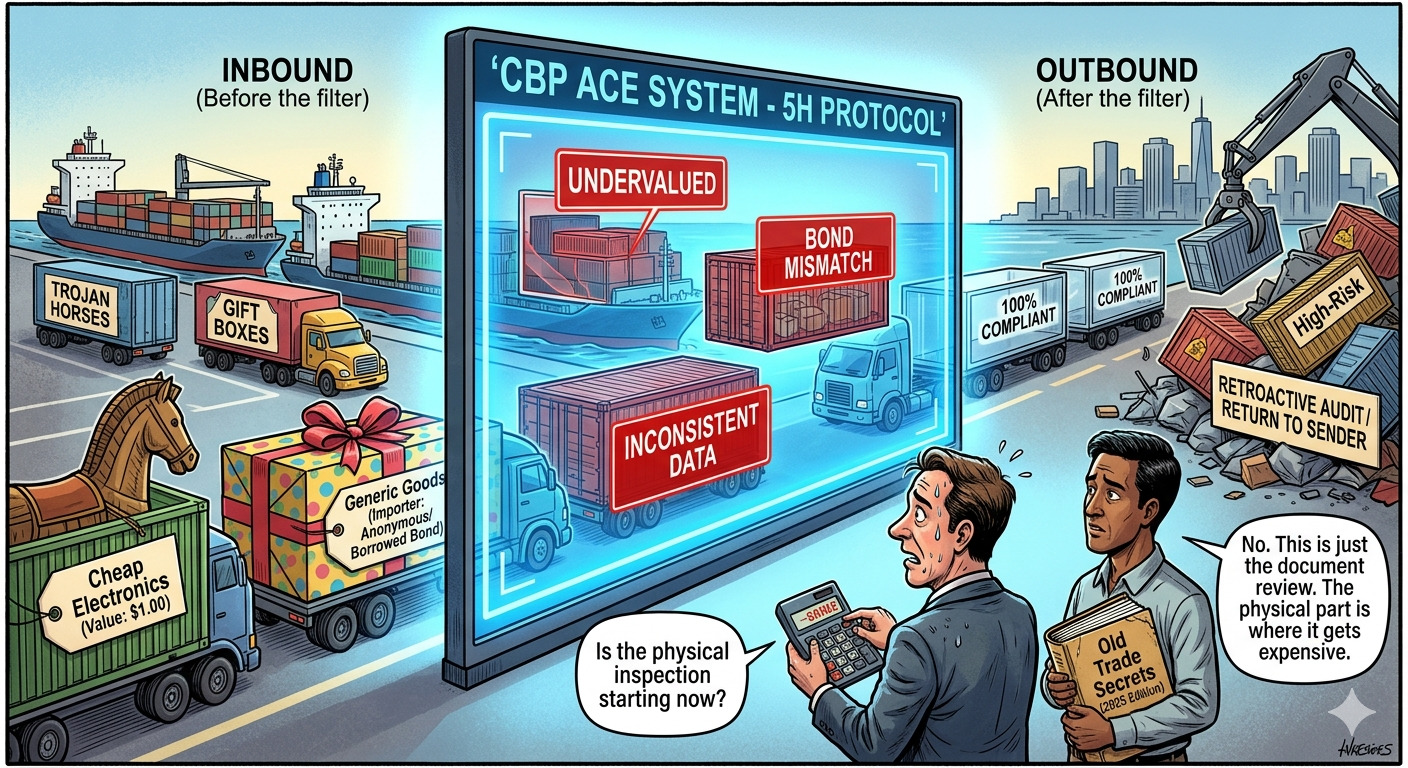
- Undervaluation of Goods: Some freight forwarders use “low-price clearance” or “all-inclusive tax/inspection” as selling points, deliberately lowering the declared value to reduce tariff costs. However, the U.S. Customs ACE (Automated Commercial Environment) system now possesses the capability to compare historical transaction data with market prices. If a declared price deviates significantly from the norm, the system automatically flags it. If deemed malicious undervaluation, goods are usually ordered for immediate return with almost no room for negotiation.
- “Bond Borrowing” for Clearance: In cross-border logistics, some forwarders borrow another party’s Bond guarantee to clear customs for multiple owners under a single importer of record. While common in “double-clearance tax-inclusive” models, this is illegal under U.S. law. Per regulations, the entity responsible for clearance must be the actual importer. Since March 1, 2026, U.S. Customs has explicitly strengthened enforcement against “Bond Borrowing.” If verified, entry is denied, resulting in high return shipping costs.
Additionally, vague product descriptions, inconsistent documentation, new importers with no prior record, or mixing sensitive goods with infringing products are also categorized as high-risk.
The 5H Upgrade: Document Review First, Physical Inspection Second
The core of this operation is the “5H Inspection.”
5H stands for “Entry Processing HOLD,” a formal detention instruction issued within the U.S. Customs filing system. Once flagged, the system immediately freezes the release and transit of the goods, and port fees begin to accrue.
Unlike traditional random physical exams, the 5H model is characterized by “Document Audit First, Physical Check Second.” Customs first performs multiple rounds of cross-verification on commercial invoices, packing lists, manifest information, and importer qualifications.
- Compliant Documents: Goods are released.
- Discrepancies Found: Goods are moved to physical “tailgate” or intensive exams, leading to potential back-taxes, destruction, or forced return.
The operation is reportedly led by a newly formed Rapid Document Review Team within CBP. The scope of review has expanded from single entry documents to the entire trade chain—including purchase contracts from domestic manufacturers, transport documents, and even terminal sales records.
Industry Shake-up and Compliance Re-alignment
Analysts believe this crackdown is not a temporary measure but a systematic overhaul targeting long-standing trade compliance issues. As regulation escalates, the compliance threshold for U.S.-bound logistics is rising rapidly.
The statute of limitations for tariffs has also been extended. Under the latest policy, U.S. Customs can initiate retroactive audits on goods suspected of false declaration for up to 5 years after entry. This means even if goods have cleared customs, the importer could still face back-taxes, fines, or even criminal prosecution in the future.
The first quarter of 2026 is expected to be a “shakedown period” for the logistics industry. Models relying on “gray area” operations will face immense survival pressure. For sellers, establishing a transparent, compliant trade chain will become a basic prerequisite for entering the U.S. market.
Recommendations for Cargo Owners and Forwarders
- Audit Your Data: Ensure product names, values, and party information are 100% accurate.
- Prepare Documentation: For sensitive categories, keep purchase contracts and transport documents ready for inspection.
- Choose Reliable Partners: Prioritize customs brokers and forwarders with full qualifications; avoid “Bond Borrowing.”
- Monitor Status: Closely track container status. If a 5H hold appears, cooperate immediately with your broker to provide documents and shorten the cycle.
- Contractual Clarity: Clearly define who bears the cost of inspection fees in trade contracts to avoid future disputes.