
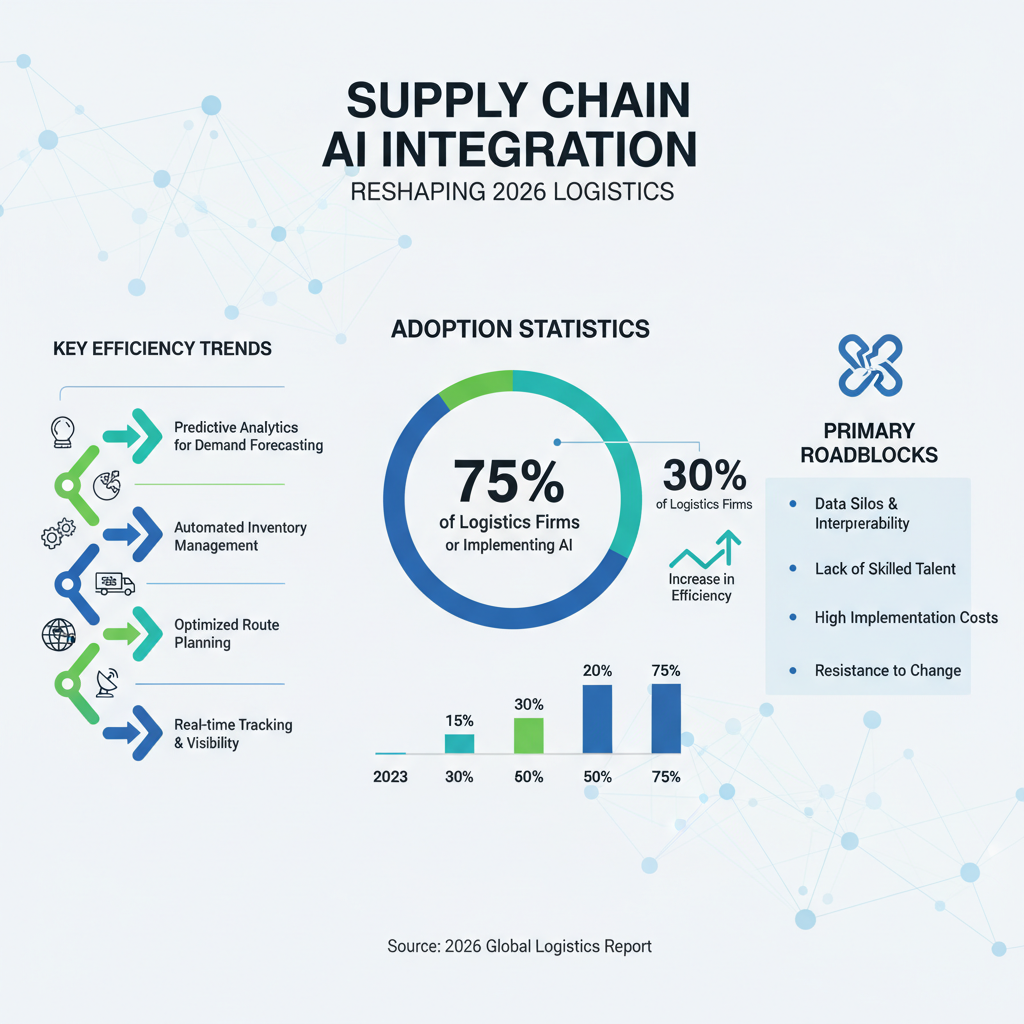
As global commerce becomes increasingly complex, Supply Chain AI Integration has transitioned from an experimental concept to a strategic necessity for logistics professionals. Industry data reveals that the AI in logistics and supply chain management market is projected to reach an impressive $47.92 billion in 2026, growing at a 41% compound annual growth rate. This explosive growth underscores a fundamental shift in how shipping experts manage inventory optimization, automated forecasting, and global transportation networks.
Integrating artificial intelligence into legacy infrastructure offers measurable advantages for forward-thinking logistics companies. Current statistics demonstrate the powerful return on investment of these implementations:
- Operational Efficiency: Surveys indicate that 72% of manufacturers report reduced costs and improved operational efficiency after deploying AI technology.
- Enhanced Visibility: Approximately 51% of supply chain operators experience better operational responsiveness and end-to-end visibility following AI adoption.
- Competitive Advantage: According to industry research, 68% of manufacturing leaders now consider AI foundational to their future competitiveness.
Despite the massive potential, Supply Chain AI Integration is not without its hurdles. Logistics experts must navigate high initial implementation costs, complex data synchronization across siloed systems, and the crucial need for staff upskilling. To secure long-term resilience, businesses must shift from fragile, efficiency-centric structures to adaptive networks powered by AI and predictive modeling. Moving forward, successful integration will depend heavily on hybrid human-AI collaboration and robust digital twin technologies.
References
Integrating digital twins and AI-augmented predictive analytics (2025). Quality Magazine: Growing Role of AI in Manufacturing (2025). Times Of AI: Transforming SCM with Predictive Analytics (2025). AI in Logistics and Supply Chain Management Market Report (2026).