
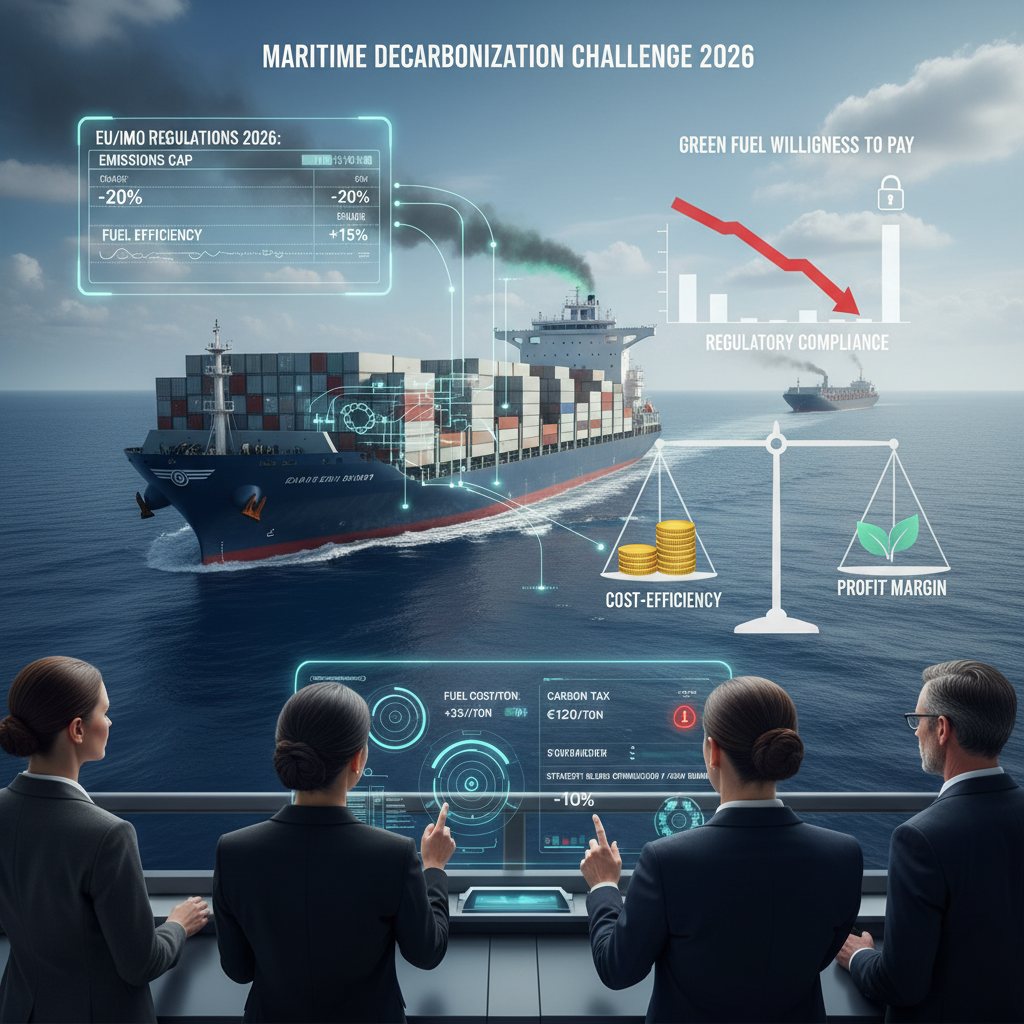
The landscape of Maritime Decarbonization in 2026 is defined by tightening regulations and complex economic realities. The European Union Emissions Trading System (EU ETS) has escalated its requirements, now mandating that shipping companies surrender allowances for 70% of their reported emissions on EU voyages, up from 40% in the previous cycle. Concurrently, the International Maritime Organization (IMO) reinforced its Net Zero Framework at the MEPC 84 session in May 2026, keeping a global fuel standard and a greenhouse gas pricing mechanism on track for potential adoption at MEPC 85.
Despite regulatory momentum, carriers face significant economic pressures. A 2026 Boston Consulting Group survey revealed that the average willingness to pay a premium for low-carbon fuels dropped to 3%, a decline from 4.5% in 2024. This price sensitivity is largely driven by volatile geopolitical landscapes, high capital costs for retrofitting, and uncertainty over mid-term fuel availability. Consequently, logistics operators are prioritizing operational efficiencies and selective pockets of high-demand green value to maintain competitiveness.
Technological advancement remains the cornerstone of long-term sustainability. The IMO finalized interim safety guidelines for alternative fuels like methanol, ammonia, and hydrogen, moving these options closer to commercial deployment. While electric propulsion is gaining traction for short-sea shipping, deep-sea vessels will increasingly rely on cross-sector partnerships to secure a stable, affordable supply of scalable zero-emission fuels.
References
- Global Maritime Forum, Statement on MEPC 84.
- BCG, Demand for Low-Carbon Shipping Has Fallen.
- UNFCCC, Climate Action in Shipping Progress.
- Strategic Roadmap for Maritime Decarbonization.
- BCG, How Other Sectors Will Fuel Maritime Decarbonization.
- MDPI, Sustainable Maritime Decarbonization Review.