

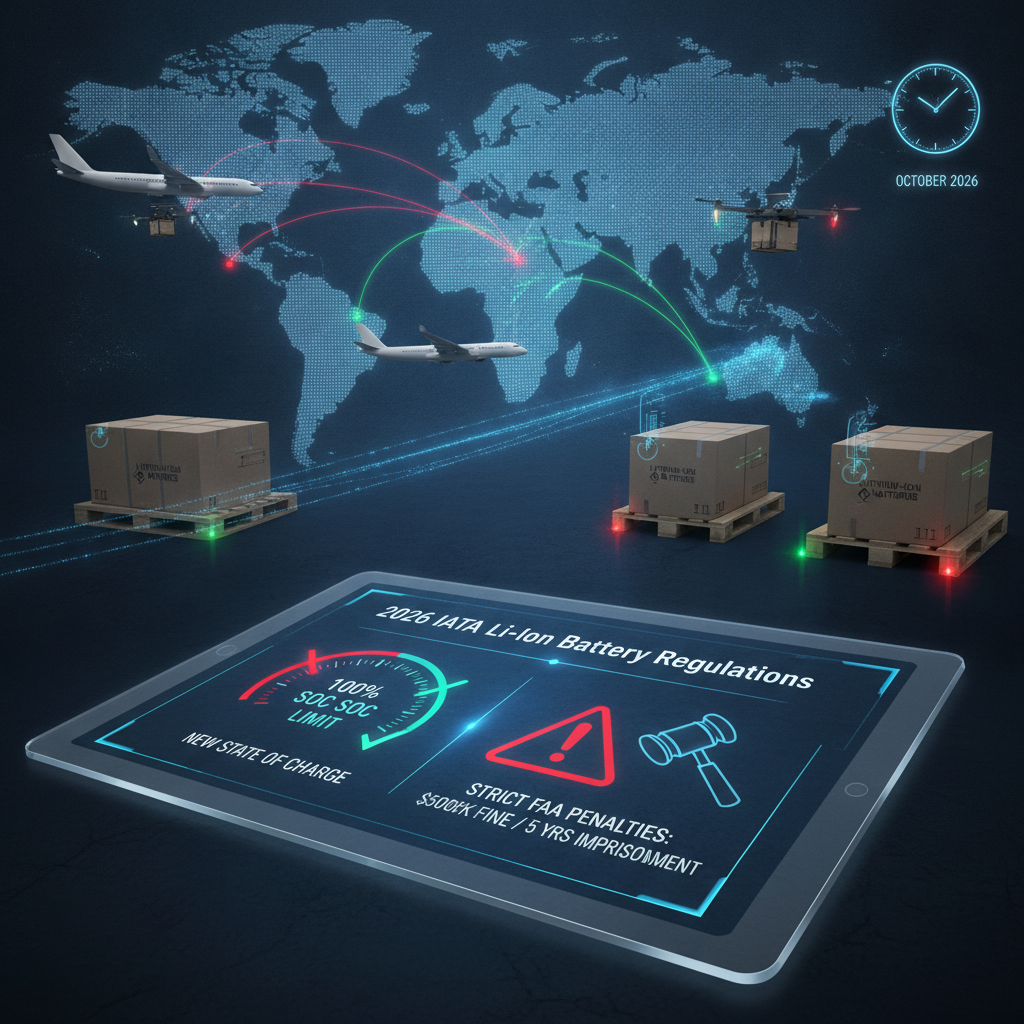
As the global lithium-ion battery market reached an estimated $73.0 billion in 2025, the logistics industry is facing unprecedented regulatory scrutiny. The core of lithium-ion battery shipping safety lies in mitigating the devastating risks of thermal runaway—a self-heating chain reaction capable of causing uncontrollable fires. With UK fire brigades alone reporting a 93% rise in lithium-ion battery fires since 2022, aviation authorities and insurers are heavily penalizing non-compliance. In fact, the Federal Aviation Administration (FAA) is enforcing strict penalties, issuing fines up to $186,610 for serious violations involving undeclared or improperly packaged shipments.
For logistics and shipping experts, the most critical shift is the transition of State of Charge (SoC) guidelines from recommendations to international law. Starting January 1, 2026, under the International Air Transport Association (IATA) 67th Edition Dangerous Goods Regulations, mandatory SoC limits will be strictly enforced.
- 30% SoC Limit: Standalone lithium-ion batteries (UN 3480) and batteries packed with equipment (UN 3481 > 2.7 Wh) must not exceed a 30% charge limit for air freight.
- New UN Classifications: Battery-powered vehicles, including e-bikes and e-scooters (>100 Wh), now fall under UN 3556 and face the same stringent 30% maximum charge cap.
- Zero Tolerance: Shipments arriving at terminals with a 50% charge will face immediate rejection, incurring heavy missed-flight penalties and storage fees.
To ensure robust lithium-ion battery shipping safety, forward-thinking freight forwarders must pivot toward digitized compliance. Experts recommend integrating Dangerous Goods (DG) data fields directly into Enterprise Resource Planning (ERP) systems to auto-populate electronic Air Waybills (e-AWBs). Furthermore, standard operating procedures must be established with overseas suppliers to document active battery discharging before transit. By treating these 2026 regulations as a strategic baseline rather than a burden, logistics providers can turn compliance into a competitive advantage.
References
- A&S Power – Crack Down on Hidden Lithium ion Battery Shipments
- Scribd – Lithium Battery Shipments
- JALCARGO – Dangerous Goods Handling in Japan Airlines from January 2026
- Lion Technology – 2026 Lithium Battery State of Charge Cheat Sheet
- DHL – Shipping EVs: Navigating the 2026 Battery Regulations
- Gerudo Logistics – How to Ship Lithium Battery Products from China in 2026
- QBE – Lithium battery risks in 2025: What’s changed and how to protect yourself
- Research Nester – Lithium-Ion Battery Market | Global Market Analysis Report – 2035