

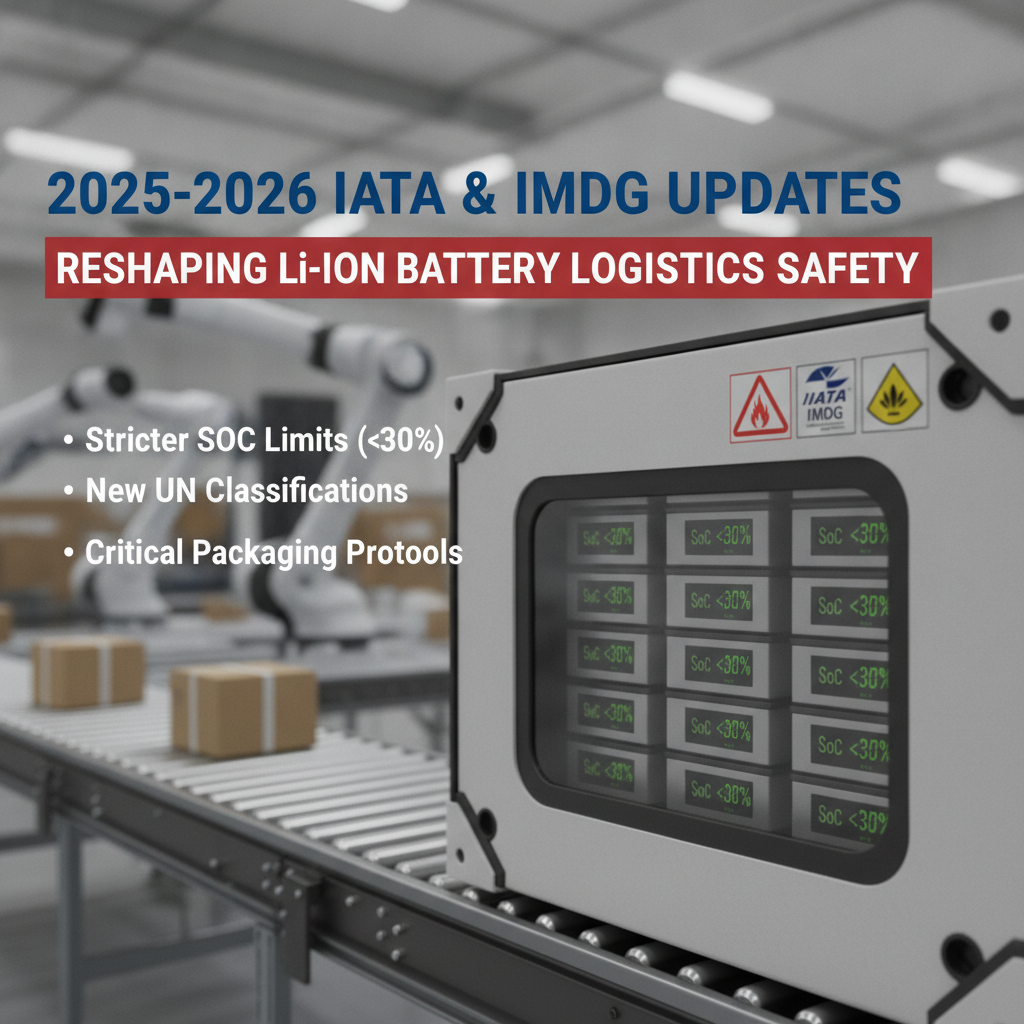
As global reliance on electric vehicles and portable power systems accelerates, maintaining optimal Lithium-Ion Battery Logistics Safety has become an urgent priority for international shipping networks. To combat the severe risks of thermal runaway, regulatory bodies have activated stringent transportation protocols spanning 2025 and 2026.
The newly enforced International Air Transport Association (IATA) 66th Edition and the International Maritime Dangerous Goods (IMDG) Code Amendment 42-24 have overhauled global compliance standards. Core operational updates include:
- State of Charge (SoC) Constraints: Standalone lithium-ion battery air shipments now face a rigid maximum 30% state of charge limit to dramatically reduce combustion volatility.
- Intensified Stacking Tests: Transport packages must now withstand an applied force equivalent to a 3-meter stack of identical packages for a full 24 hours without structural compromise.
- New UN Classifications: Vehicles powered specifically by lithium-ion batteries are now strictly classified under the new UN 3556 designation, phasing out the generalized UN 3171 code.
Industry experts emphasize that regulatory non-compliance not only invites substantial fines and cargo delays but also risks catastrophic safety failures. Additionally, damaged or defective batteries now trigger dedicated Special Provisions, notably SP 376 and SP 377, mandating highly specialized, approved disposal packaging and precise labeling. To ensure continuous Lithium-Ion Battery Logistics Safety, global forwarders must immediately audit their packaging protocols, integrate the updated marking nomenclature, and execute rigorous compliance training across their entire supply chain.
References
1. IATA Dangerous Goods Regulations (66th Edition, 2025) https://www.iata.org
2. International Maritime Organization (IMO) IMDG Code Amendment 42-24
3. UNECE Secretariat Amendments for UN 3556 Classifications