

Navigating the New Era of China Dual-Use Export Controls
The landscape of international shipping is undergoing a massive transformation as regulatory frameworks tighten. Following the implementation of the Regulations on the Export Control of Dual-Use Items in December 2024, supply chain professionals face unprecedented compliance hurdles. For logistics providers, managing China Dual-Use Export Controls is no longer just a regional issue, but a global operational mandate.
Recent Expansions and Extraterritorial Reach
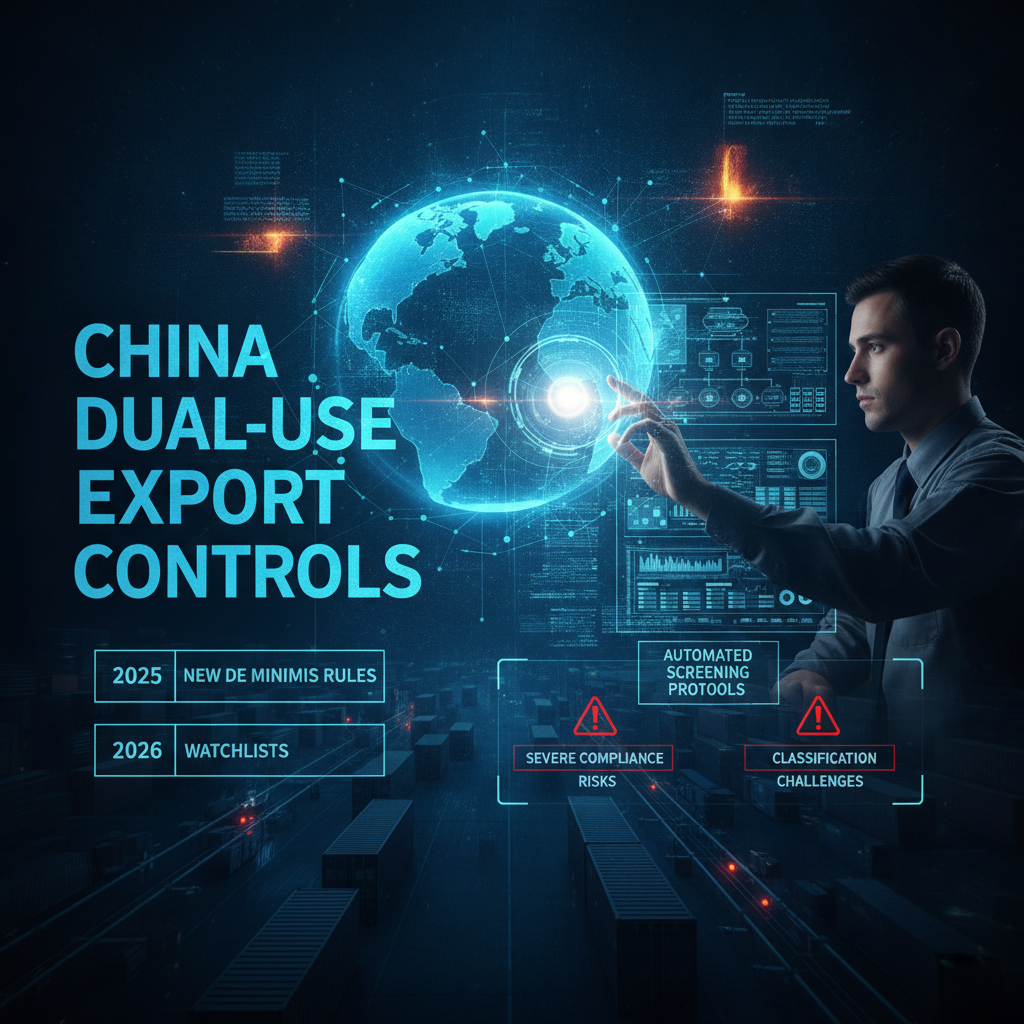
Recent 2025 expansions have introduced complex extraterritorial mechanisms. Most notably, a new 0.1% de minimis rule took effect in December 2025, which applies PRC export controls to foreign-made products containing specified PRC-origin rare-earth content. For shipping experts, this means the risk of inadvertently transporting restricted materials has skyrocketed.
- Counterparty Screening: As of mid-2026, China’s Ministry of Commerce (MOFCOM) has aggressively updated its control and watch lists, recently adding 80 Japanese entities.
- Classification Risks: Industry data indicates that over 52% of recent trade control violations originate from simple product classification errors.
- Re-Export Restrictions: Forwarders must now rigorously vet foreign-manufactured items produced with Chinese technology.
Adapting to China Dual-Use Export Controls in Logistics
To mitigate the impacts of these regulations, logistics firms must transition from manual screening to automated master data matching. Shippers should mandate that customs declarations explicitly detail technical parameters to avoid supply chain bottlenecks. Staying ahead of MOFCOM’s evolving watchlists is essential for maintaining uninterrupted global trade.
References
- TIMEWELL (2026): China’s Dual-Use Export Control List and Watch List Update
- GvW Graf von Westphalen (2025): China expands export controls briefing for European Companies