

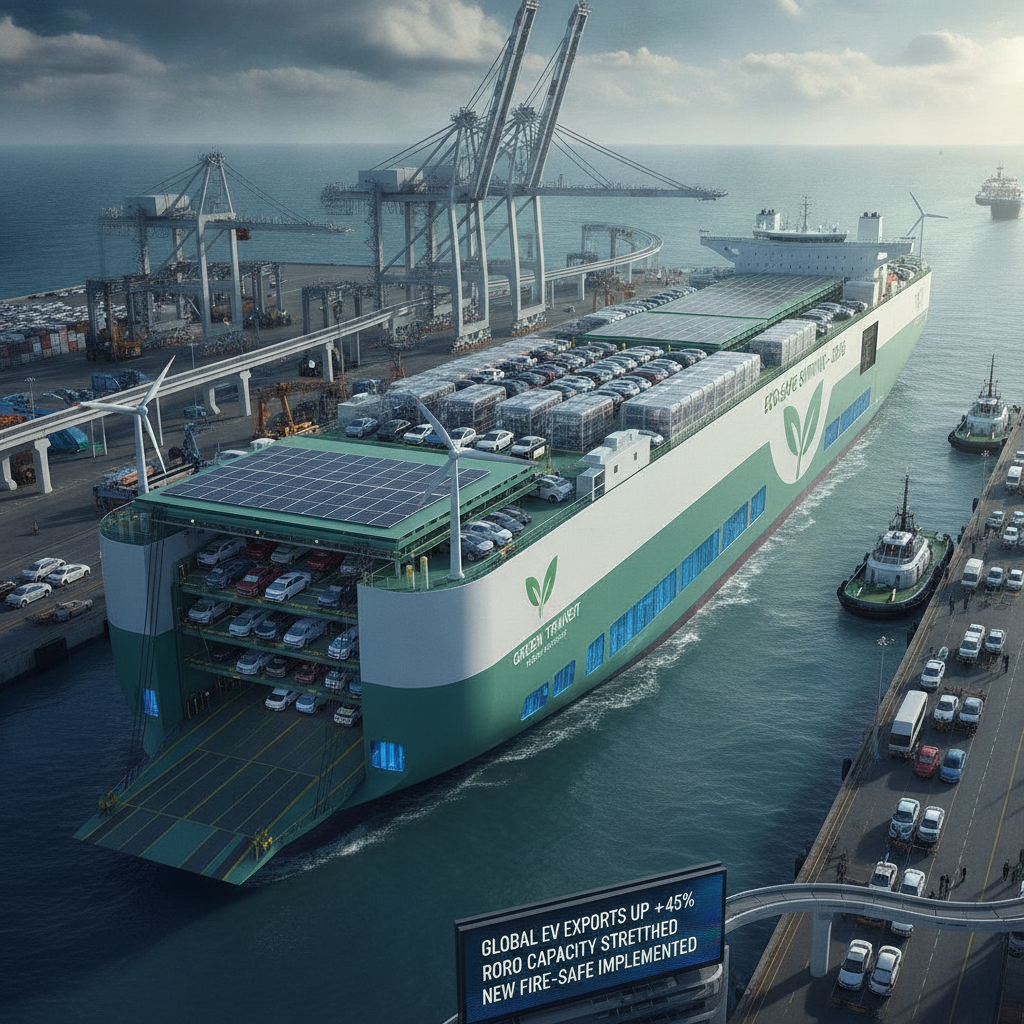
Why Are Automotive Export Cargo Flows Straining Global RoRo Capacity?
The global maritime logistics sector is experiencing unprecedented shifts as surging Automotive Export Cargo Flows redefine capacity demands. Driven largely by the exponential growth of Chinese electric vehicle (EV) exports, deep-sea light-vehicle shipments increased by an estimated 10% in 2025. As a result, the Roll-on/Roll-off (RoRo) shipping market, valued at a projected $23.43 billion in 2026, faces acute vessel availability shortages and rapid structural transformation.
Key Drivers Disrupting Automotive Export Cargo Flows
In response to volatile trade route dynamics, logistics providers are overhauling traditional supply chains. Several critical factors are influencing current capacity:
- Chinese Export Surge: Chinese passenger vehicle exports topped 919,000 units in September 2026 alone, representing a 64% year-over-year increase. Automakers like BYD are deploying captive fleets capable of moving one million vehicles annually to bypass traditional maritime bottlenecks.
- Regulatory Pressures: Geopolitical tariffs and trade rules are heavily rerouting Automotive Export Cargo Flows. The US Section 301 action drastically increased port fees for Chinese imports in late 2025, while Europe is advancing quantitative restrictions on Chinese hybrid vehicle imports.
- EV Safety Innovations: With electric and hybrid vehicles making up 37.3% of new EU passenger car registrations in early 2026, the risk of lithium-ion battery thermal runaway has forced operators to invest heavily in fire-resistant decks and specialized containment technologies.
Future Outlook for Automotive Export Cargo Flows
To stabilize these intense Automotive Export Cargo Flows, the industry is prioritizing decarbonization and fleet modernization. Operators such as Kawasaki Kisen Kaisha and Wallenius Wilhelmsen rolled out LNG dual-fuel and methanol-ready vessels throughout mid-2026. While newbuild deliveries peaked in 2025, the sustained demand for emission-compliant, EV-safe transport indicates that maritime logistics costs and capacity will remain fiercely competitive through the end of the decade.
References
- RORO Shipping Market Size, Growth Potential, Share Analysis To 2035 (2026)
- Dataintelo: RORO Shipping Market Size, Share & Forecast Report 2025 to 2034
- Business Research Insights: RORO Shipping Market Trends, Analysis Report by 2035 (2026)
- Persistence Market Research: Roll-On/Roll-Off (Ro-Ro) Ship Market Forecast
- NYK Line: Analysis on the supply and demand of container ships and car carriers (2025)
- Manufacturing Today: Europe tightens automotive trade rules as Chinese imports grow (2026)