

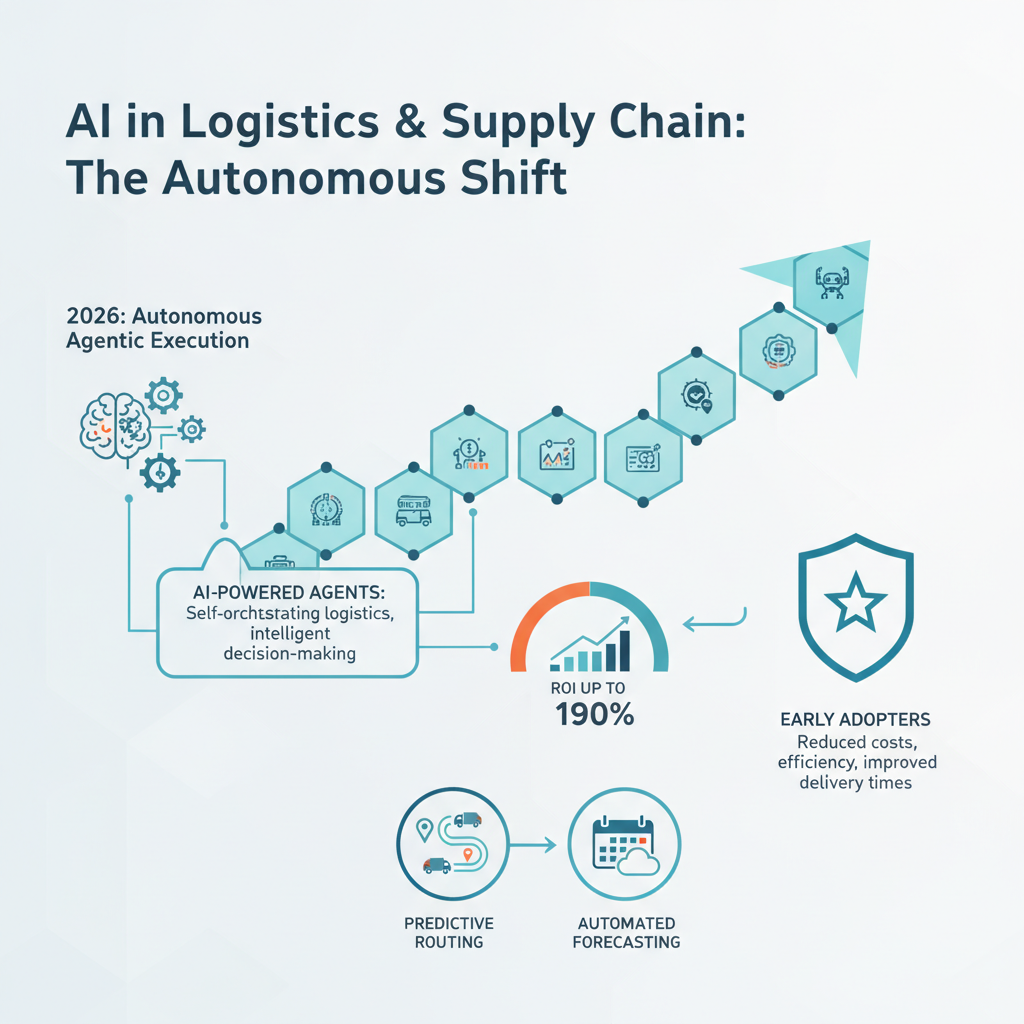
The Rise of Agentic AI in Logistics and Supply Chain
In 2026, the discussion around AI in logistics and supply chain has pivoted from theoretical optimization to autonomous execution. According to recent 2025-2026 data, while the logistics sector generates immense operational data, its overall AI adoption rate sits at just 35%. However, those crossing the adoption threshold are reaping massive rewards, reporting an average return on investment of 190%.
Market Growth for AI in Logistics and Supply Chain
The trajectory for AI in logistics and supply chain management is aggressive. Analysts forecast that supply chain software featuring agentic AI will explode from under $2 billion in 2025 to $53 billion by 2030. Rather than merely offering predictive analytics, these autonomous agents are now executing real-time decisions, such as dynamically re-routing shipments and balancing inventory.
High-Yield Operational Use Cases
Leading logistics providers are leveraging this technology to optimize network-wide efficiency. Key applications driving the current market include:
- Route Optimization: AI-driven load consolidation and routing are cutting total logistics costs by 10% to 15%.
- Autonomous Orchestration: By 2026, nearly 40% of enterprise applications are integrating task-specific AI agents into core workflows.
- Demand Forecasting: Enhanced machine learning models are improving regional forecast accuracy by up to 20%, reducing unnecessary product movements.
The Road Ahead for AI in Logistics and Supply Chain
Despite clear financial incentives, many operators remain trapped in ad-hoc experimentation due to legacy system constraints. To remain competitive, supply chain leaders must treat AI implementation as a fundamental operational redesign.
References
Gartner Supply Chain Technology Report 2025 via The Thinking Company.
Innowise AI in Supply Chain and Logistics Report 2026.
QuickFMS AI in Logistics and Supply Chain Management 2026.
Brain AI Supply Chain Management Analysis 2026.
PwC Supply Chain Planning Report 2026.