

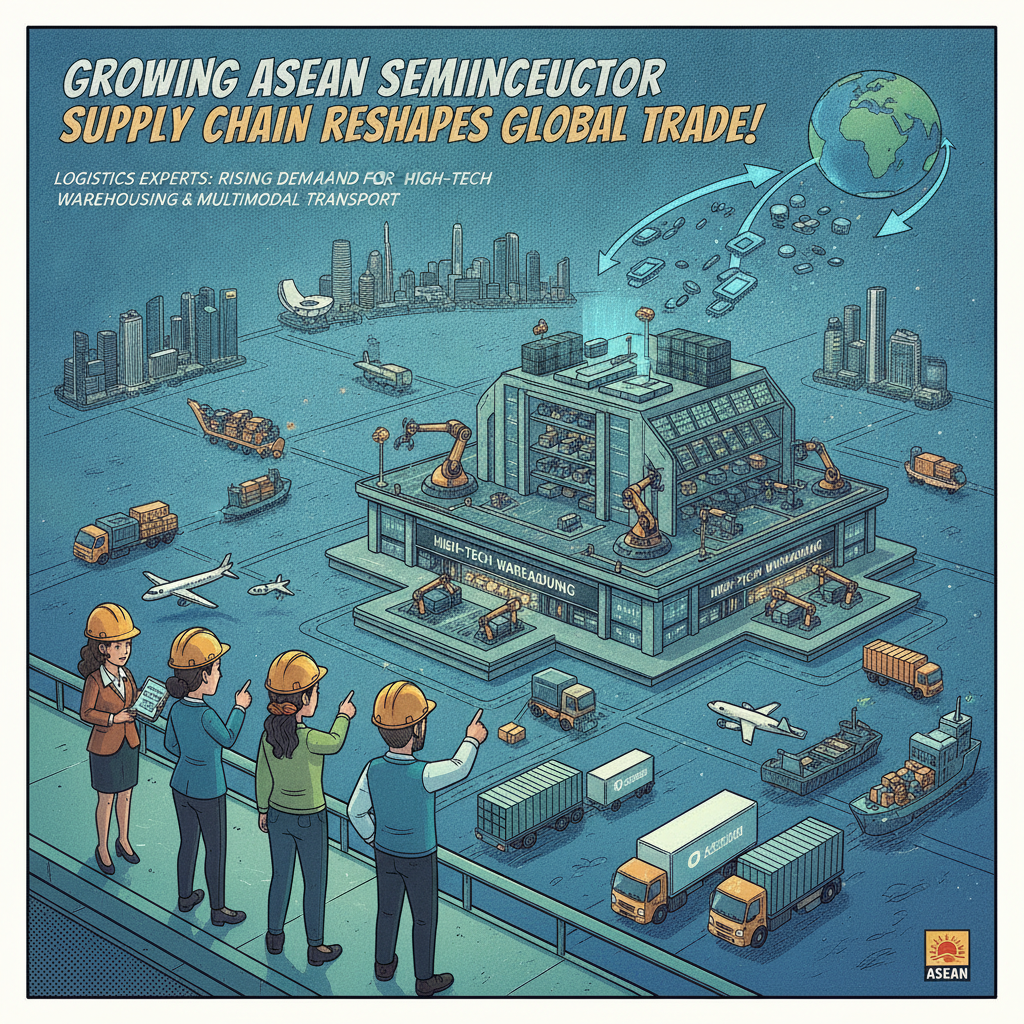
Can the ASEAN Semiconductor Supply Chain Transform Global Logistics?
The global tech industry is diversifying, positioning Southeast Asia as a vital manufacturing hub. As of 2025, the ASEAN semiconductor supply chain has expanded rapidly, with the regional market reaching USD 135.43 billion. For logistics and shipping experts, this surge demands highly specialized, resilient freight networks capable of handling sensitive electronics.
Integrating a Regional Framework
To streamline complex trade routes, regional leaders introduced the ASEAN Framework for an Integrated Semiconductor Supply Chain (AFISS) to harmonize regulations. Consequently, the regional logistics market, valued at USD 288 billion in 2025, is seeing heavy investments in multimodal transport and bonded warehouses. Forwarders must adapt to moving high-value components seamlessly across multiple borders.
Key Nodes in the ASEAN Semiconductor Supply Chain
Three primary economies dictate the flow of the ASEAN semiconductor supply chain: Vietnam, Malaysia, and Singapore. Vietnam offers a rapidly expanding manufacturing base, Malaysia dominates backend packaging, while Singapore leads in advanced R&D. Moving semi-finished chips between these nodes requires temperature-controlled transit, cleanroom-level handling, and real-time tracking systems.
References
- ASEAN Investment Report 2025: Foreign Direct Investment
- ASEAN-BAC: Shaping ASEAN’s Semiconductor Supply Chain Potential
- Mordor Intelligence: ASEAN Semiconductor Market Size 2030