
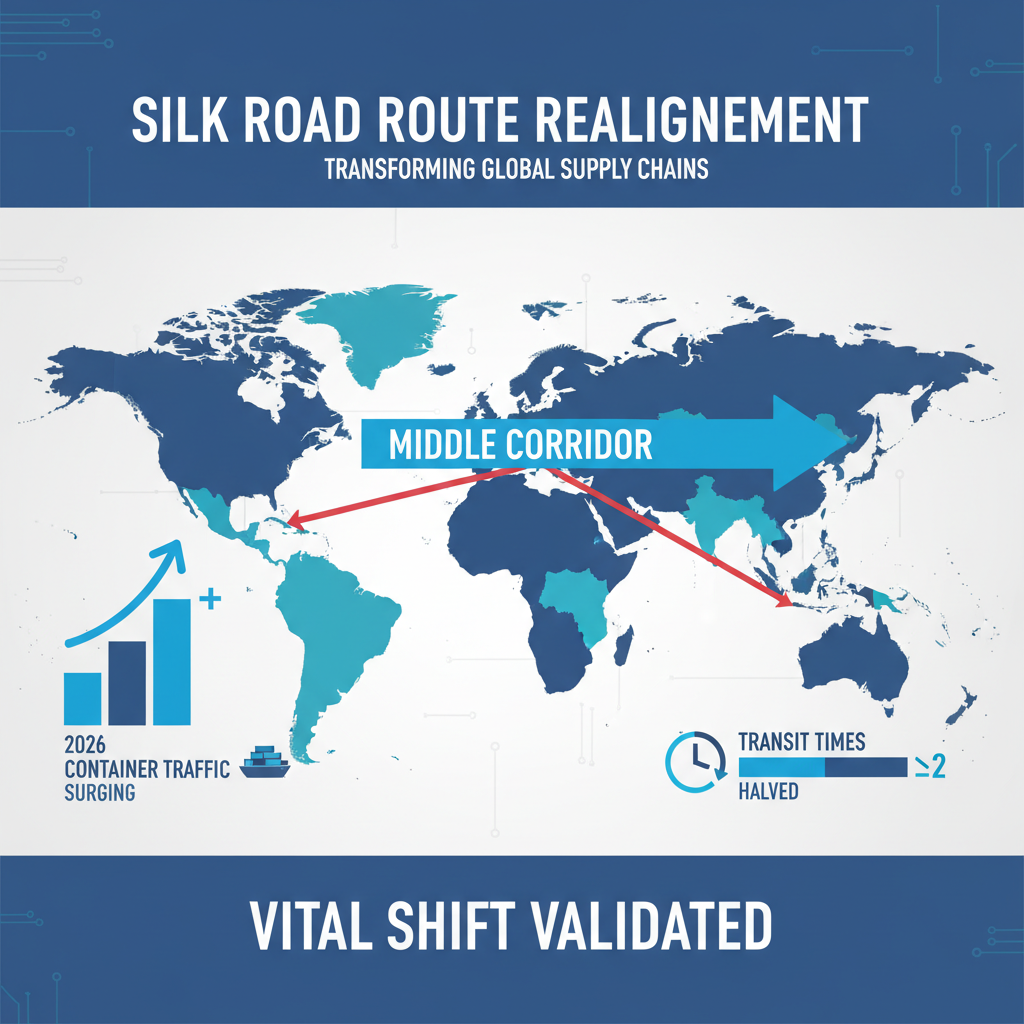
The global shipping landscape is undergoing a profound transformation, heavily influenced by the ongoing Silk Road Route Realignment. Geopolitical tensions across traditional Northern corridors and persistent maritime disruptions in the Suez Canal have forced logistics operators to secure alternative supply chains. Consequently, the Trans-Caspian International Transport Route (TITR), widely known as the Middle Corridor, has emerged not merely as a backup, but as a primary multimodal artery connecting China to Europe.
Recent data from 2025 and early 2026 highlights a definitive structural shift in Eurasian freight operations. Infrastructure investments and harmonized customs procedures have drastically improved the corridor’s viability for high-value freight.
- Container traffic surged by 36% in 2025, reaching approximately 77,000 TEUs.
- Total freight volumes processed through the Middle Corridor surpassed 4.1 million tonnes annually.
- Transit times between China and Europe have been slashed from over 30 days to an average of 13 to 17 days.
For logistics experts, adapting to the Silk Road Route Realignment requires immediate strategic positioning. Governments across Kazakhstan, Azerbaijan, and Georgia are actively scaling infrastructure, including expanding Ro-Ro berths in Baku and dredging ports at Kuryk and Aktau. With regional authorities targeting 300,000 TEUs by 2029, forwarders must integrate Middle Corridor capacity into their core service offerings to ensure resilient supply chains.
References
Kazakh Ministry of Transport: Trans-Caspian Transport Route Cargo Volumes Increase. BMG: Container Traffic Surges on Trans-Caspian Middle Corridor.