

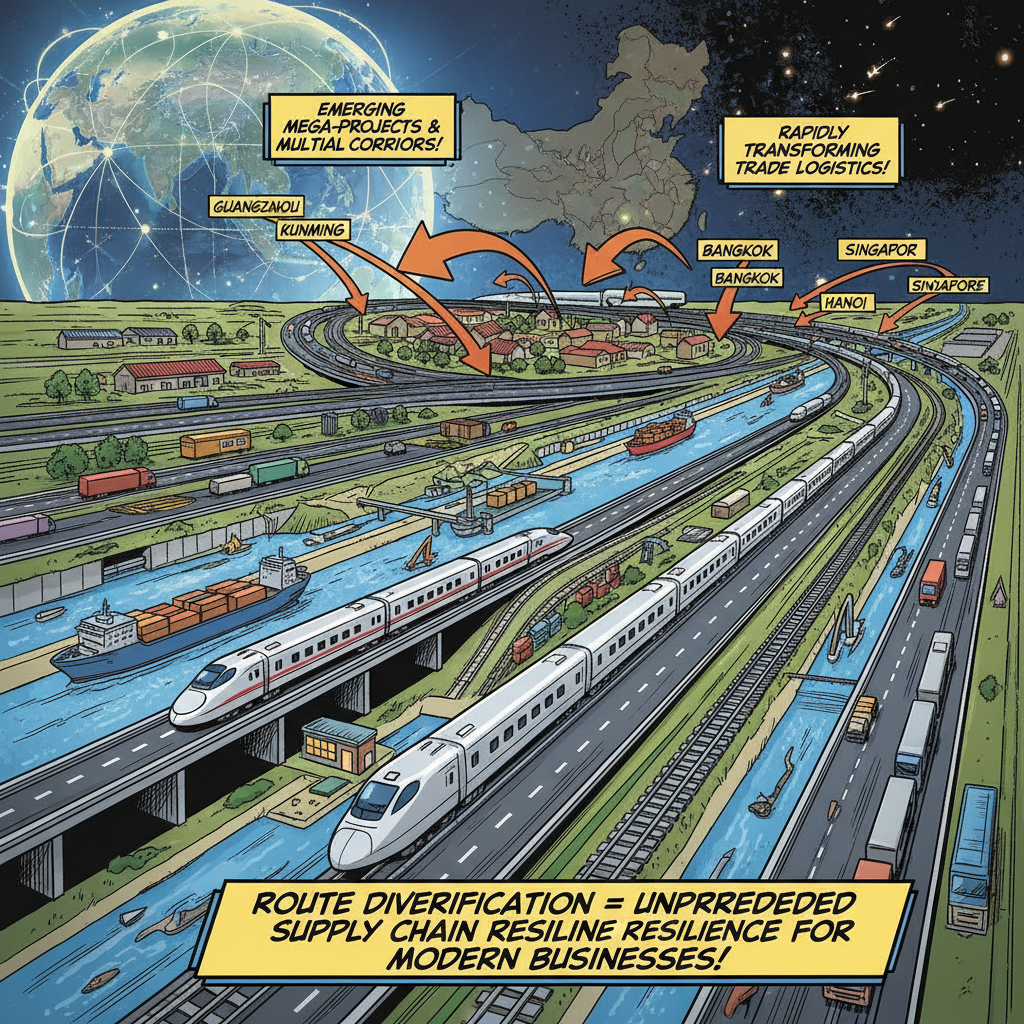
As ASEAN solidifies its position as China’s largest trading partner, the landscape of China-ASEAN Trade Logistics is undergoing a massive transformation. In the first quarter of 2025, ASEAN’s share of China’s total foreign trade rose to 16.6%, driven largely by high-value manufacturing goods like lithium batteries and automotive parts. This rapid growth has necessitated significant investments in cross-border infrastructure and supply chain resilience.
To accommodate surging bilateral volumes, trade routes are being rapidly diversified beyond traditional east-coast shipping lanes. Recent developments highlight critical strategies reshaping China-ASEAN Trade Logistics:
- The Pinglu Canal: Backed by a 70 billion yuan investment, this historic waterway is redrawing maritime networks and significantly shortening shipping distances between southwestern China and Southeast Asian ports.
- The New International Land-Sea Trade Corridor: This inland-to-ocean network offers businesses scalable southbound options, accelerating transit times and enhancing agility.
- Transshipment and FDI Synergy: Surging Chinese foreign direct investment in Vietnam, Thailand, and Indonesia is buffering regional trade against global tariff exposures.
For logistics professionals, optimizing operations now requires leveraging these emerging multi-modal corridors. Upgraded trade facilitation measures and deep industrial integration are enhancing supply chain resilience. Businesses must prioritize route diversification and utilize the expanded inland-ASEAN connections to maintain a competitive edge in 2026.
References
The Business Times: Pinglu Canal: Redrawing China-Asean trade routes (https://www.businesstimes.com.sg).
China’s New Land-Sea Trade Corridor: Implications for Businesses.
Global Times: ASEAN’s share of China’s foreign trade rises to 16.6% in Q1 2025.
S&P Global: Transshipment: Outlook and Implications for ASEAN.
RCEP and the Vision of the Maritime Silk Road.