
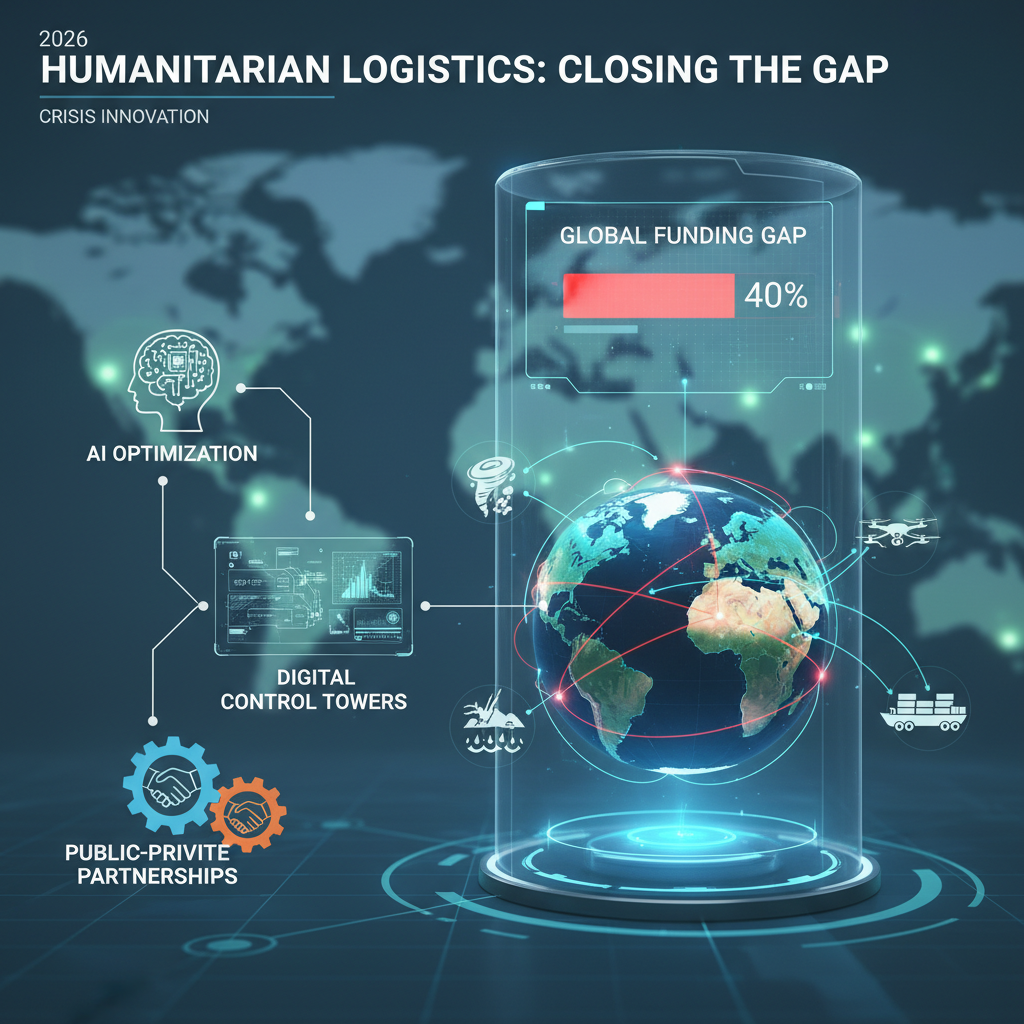
The global logistics sector faces an unparalleled stress test. In 2026, the UN Office for the Coordination of Humanitarian Affairs (OCHA) reports that global humanitarian funding gaps exceed 40%. Simultaneously, over 300 million individuals require immediate assistance due to geopolitical conflicts and climate shocks. For shipping experts, managing Humanitarian Supply Chain Challenges requires moving beyond reactive disaster response toward predictive, tech-enabled resilience.
Despite the critical need for supply chain agility, technological adoption remains a massive hurdle. A recent CHORD survey by Kühne Logistics University reveals that over 80% of humanitarian operations rarely use advanced technologies like AI due to persistent funding deficits. This disconnect directly impacts end-to-end visibility in austere environments. To combat this, leading humanitarian agencies are deploying centralized control tower architectures. These unified digital dashboards consolidate fragmented procurement and transport data, generating real-time insights that prevent delivery delays.
The path forward demands robust public-private partnerships. Key focus areas include:
- Data Integration: Utilizing control tower models for cross-organizational visibility.
- Local Sourcing: Transitioning to localized procurement to build regional supply resilience.
- Emissions Tracking: Improving operational sustainability, as currently fewer than 50% of humanitarian logistics teams consistently measure their carbon footprint.
Ultimately, overcoming complex Humanitarian Supply Chain Challenges requires commercial shipping leaders to share scalable innovations. Professionalizing these critical aid networks can directly offset funding gaps through measurable operational efficiency.
References
HELP Logistics, The State of Logistics and Supply Chain in the Humanitarian Context 2024.
CHORD, Global Survey Findings (2025).
HELP Logistics Annual Report & UN OCHA Data (2026).