
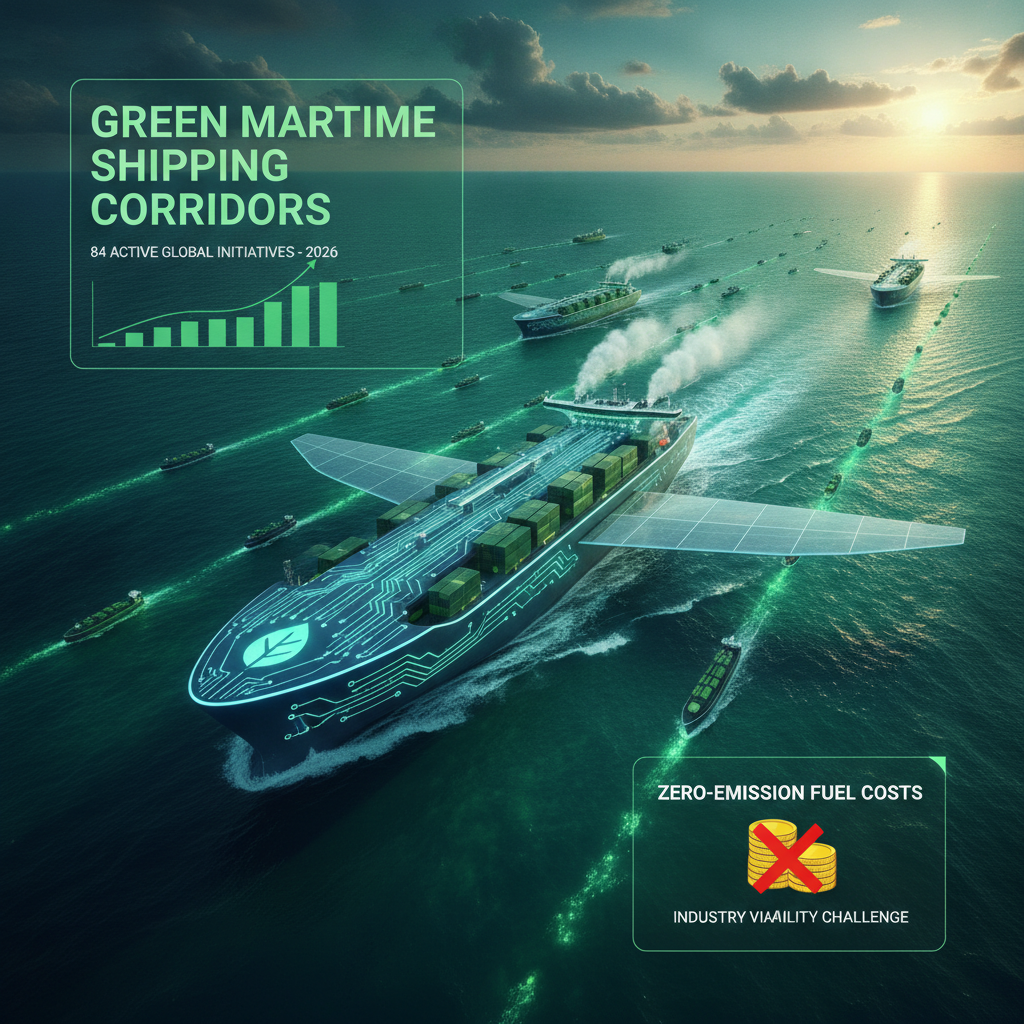
The transition toward zero-emission maritime logistics is accelerating through the targeted development of Green Maritime Shipping Corridors. These dedicated trade routes test and scale zero-emission technologies in real-world environments.
Recent 2026 industry data reveals significant momentum in global decarbonization. According to the Global Maritime Forum, there are now 84 active green corridor initiatives worldwide, adding 25 new projects recently. This expansion includes developing economies like China, India, and Brazil, highlighting broad economic opportunities.
While many initiatives remain exploratory, the sector has crossed a historic threshold. Four distinct corridors have reached the realisation stage, involving active construction of zero-emission vessels and infrastructure. Operators focus on these priority fuels:
- Green Methanol: Targeted for dual-fuel vessels between 2026 and 2030.
- Ammonia: Actively tested for deep-sea freight.
- Hydrogen: Deployed for short-sea regional routes.
Despite regulatory pushes like the 2025 FuelEU Maritime regulation, many corridors remain stalled. Stakeholders face a feasibility wall driven by the stark cost gap between conventional and zero-emission fuels. Bridging this gap requires synchronized financial frameworks and targeted policy interventions, particularly following the delay of the IMO Net-Zero Framework to 2026.
References
Decarbonizing Maritime Shipping. Global Maritime Forum 2025 Report. Green Corridors Progress. GMF Annual Report 2024. Climate Action Tracker 2026. S&P Global Updates.