
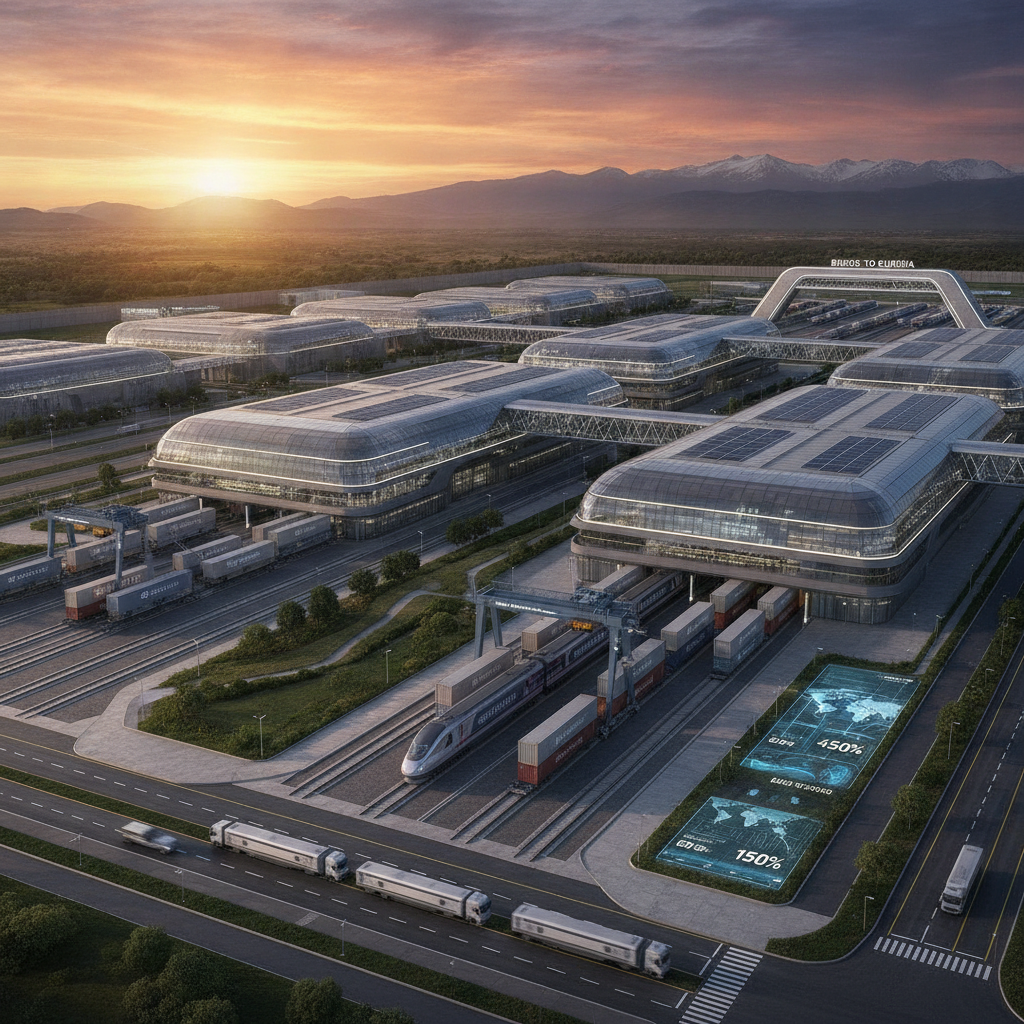
Recent developments have transformed the Kazakhstan-China Border Logistics Hub [1.1.7] into a high-tech epicenter for transcontinental freight. In May 2026, CEVA Logistics launched a 4,300-square-meter automated distribution center in Alashankou, just 15 minutes from the border. Utilizing AI-based measurement, RFID, and electric autonomous forklifts, the facility completes cargo consolidation in just 6 to 12 hours while reducing CO2 emissions by 46% compared to traditional models.
The operational capacity within the region is scaling rapidly to meet rising freight demand. Throughout 2025, the Khorgos Gateway handled over 372,000 TEUs, a 2% year-over-year increase. The addition of ten new broad-gauge rail lines and intelligent infrastructure upgrades slashed container transfer times from five hours to merely one hour. Concurrently, Kazakhstan is developing the 8,400-hectare Kolzhat Dry Port, with the first phase set to launch by late 2026, which is projected to triple local cargo traffic to 1.4 million tons by 2030.
Bilateral trade between Kazakhstan and China’s Xinjiang region reached $18.9 billion in 2025, highlighting the vital economic role of cross-border operations. Driven by the Smart Customs digital ecosystem, which integrates unmanned transportation and electronic declarations by April 2026, these multimodal hubs are heavily streamlining Eurasian transit. For logistics professionals, these continuous upgrades solidify the route’s resilience, speed, and critical importance to global supply chains.
References
- CEVA Logistics Automated Distribution Center (May 2026) – https://www.cevalogistics.com/
- Khorgos Dry Port TEU Traffic Data (Feb 2026) – https://www.trend.az/
- Kolzhat Dry Port Developments (Sept 2025) – https://astanatimes.com/