

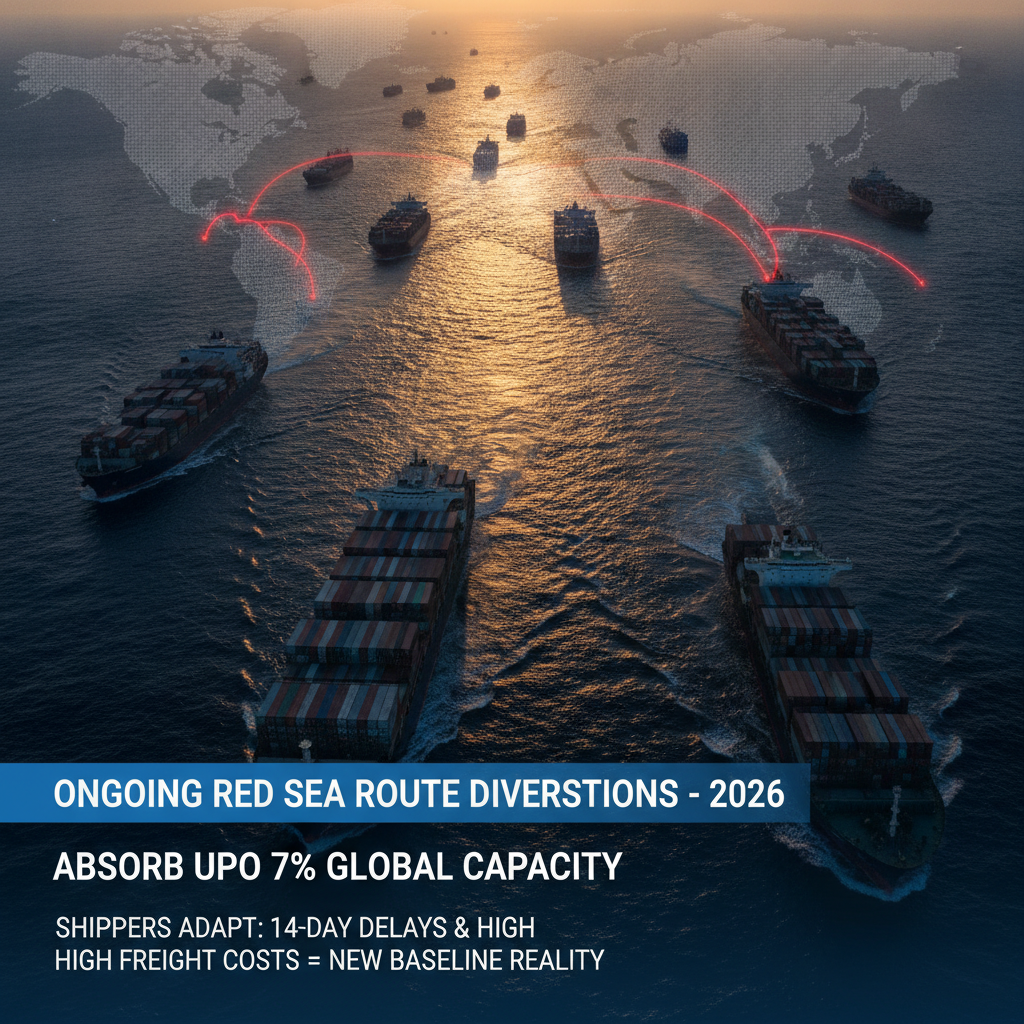
In 2026, the maritime logistics industry continues to grapple with the profound operational impact of ongoing Red Sea Route Diversions. What was initially treated as a temporary disruption has now become the baseline reality for global supply chains, fundamentally altering transit expectations and cost structures for Asia-Europe and transpacific trade lanes.
The Heavy Toll of Red Sea Route Diversions
The avoidance of the Suez Canal in favor of the Cape of Good Hope has created substantial bottlenecks across the shipping sector. Current industry data illustrates the stark reality of these extended voyages:
- Transit Delays: Cape diversions consistently add 10 to 14 days to standard Asia-Europe sailing schedules.
- Capacity Squeeze: The extended routes have absorbed an estimated 5% to 7% of global container capacity, effectively removing up to 2.4 million TEU from the active market.
- Elevated Costs: Shippers face rate premiums of $1,500 to $2,500 per forty-foot equivalent unit (FEU) alongside war-risk insurance endorsements reaching 0.5% to 1.0% of cargo value.
Will Red Sea Route Diversions End Soon?
While some major carriers, including Maersk and CMA CGM, have tentatively tested phased returns to the Suez Canal in late 2026, widespread adoption remains constrained by volatile security conditions. Furthermore, logistics experts warn that an abrupt end to Red Sea Route Diversions could trigger a secondary crisis. A sudden shift back to the shorter Suez route threatens to cause severe vessel bunching, potentially overwhelming European port terminals that are already managing inland transport constraints.
Strategic Logistics Planning
Supply chain professionals must stop viewing Cape of Good Hope routings as detours and start building them into baseline forecasting. Forward-thinking shippers are mitigating risks by diversifying transport options, integrating sea-air logistics hubs like Dubai, and increasing inventory buffers to safeguard their 2026 margins against ongoing geopolitical volatility.
References
- Suaid Global (2026). Red Sea Shipping Crisis Impact.
- Seatrade Maritime News (2026). Container lines edge towards full Suez return.
- Import Intelligence (2026). 2026 Freight Market Outlook.
- Metro Global (2026). Red Sea return gathers pace.