
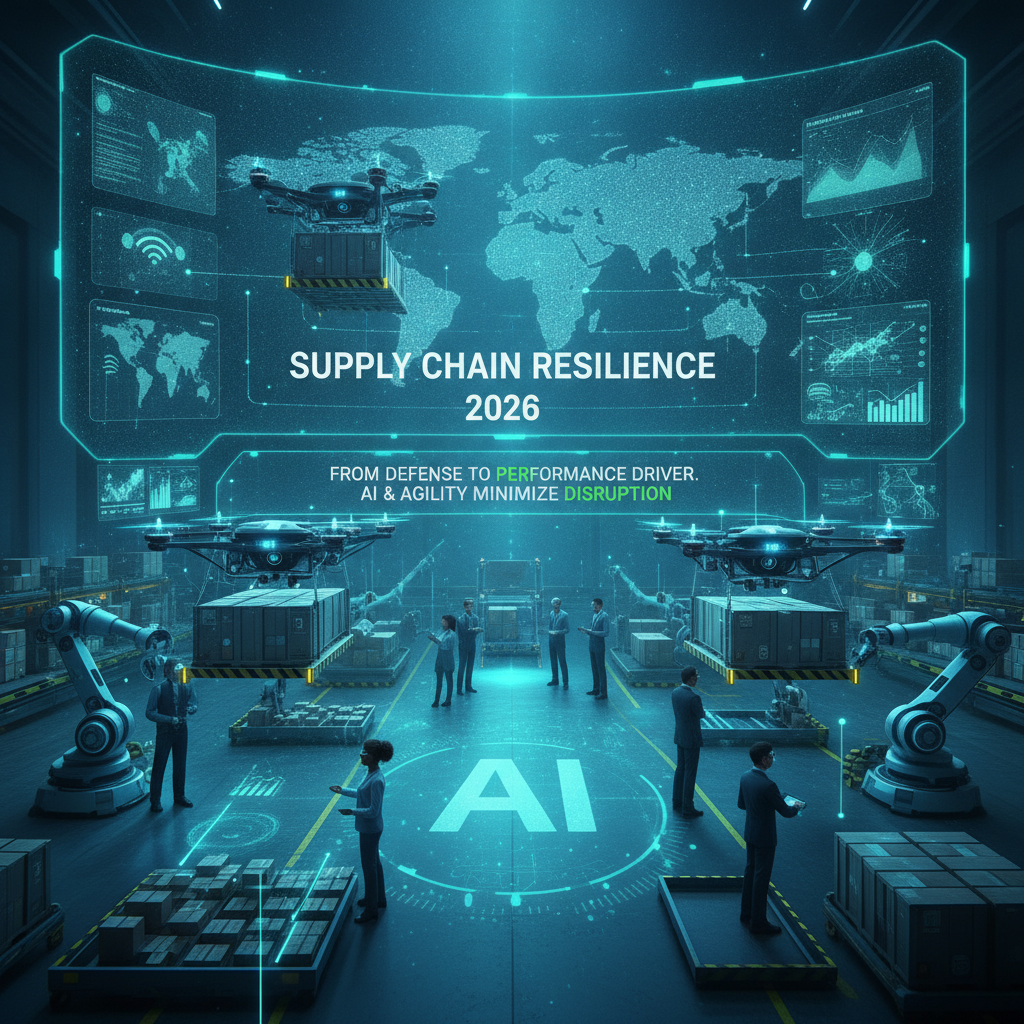
In 2026, the global logistics sector has officially shifted its perspective on Supply Chain Resilience. No longer viewed simply as a defensive mechanism against geopolitical fragmentation or climate disruptions, it has become a primary enabler of sustainable business performance. Recent industry surveys reveal that organizations acting as resilience frontrunners lost less than 1% of their revenue to disruptions, compared to an average loss of 3.9%.
Why Supply Chain Resilience is Evolving Beyond Risk Management
Historically, shipping managers relied on heavy redundancies, such as excess inventory and spare capacity, to weather global shocks. Today, building Supply Chain Resilience focuses on strategic operational optionality rather than holding expensive buffer stock. Modern logistics experts emphasize several core capabilities for continuous product flow:
- Rapidly pivoting transportation modes and shipping routes during localized port crises.
- Diversifying geographic sourcing to mitigate tariff impacts and sudden demand shocks.
- Leveraging real-time data to execute pre-approved routing alternatives instantly.
The Rise of Agentic AI in Supply Chain Resilience
The integration of advanced technology is rapidly accelerating this structural shift across the shipping sector. Agentic AI is actively reshaping Supply Chain Resilience by reducing predictive uncertainty instead of merely adding physical redundancy. Through advanced predictive analytics and autonomous real-time routing, logistics networks can sense bottlenecks faster and execute stronger decisions autonomously. Despite this technological leap, a recent World Economic Forum report highlighted that only 29% of organizations currently possess the future-ready capabilities required to fully mitigate emerging vulnerabilities. To thrive in a volatile market, shipping professionals must explicitly embed resilient frameworks into their strategic design.
References
DocShipper, 2026 Supply Chain Trends: What Importers Must Know (2026).
Maersk, Course for Change: Mastering supply chain resilience in an unconventional world (2025).
World Economic Forum, How agentic AI is reshaping supply chain resilience (2026).