

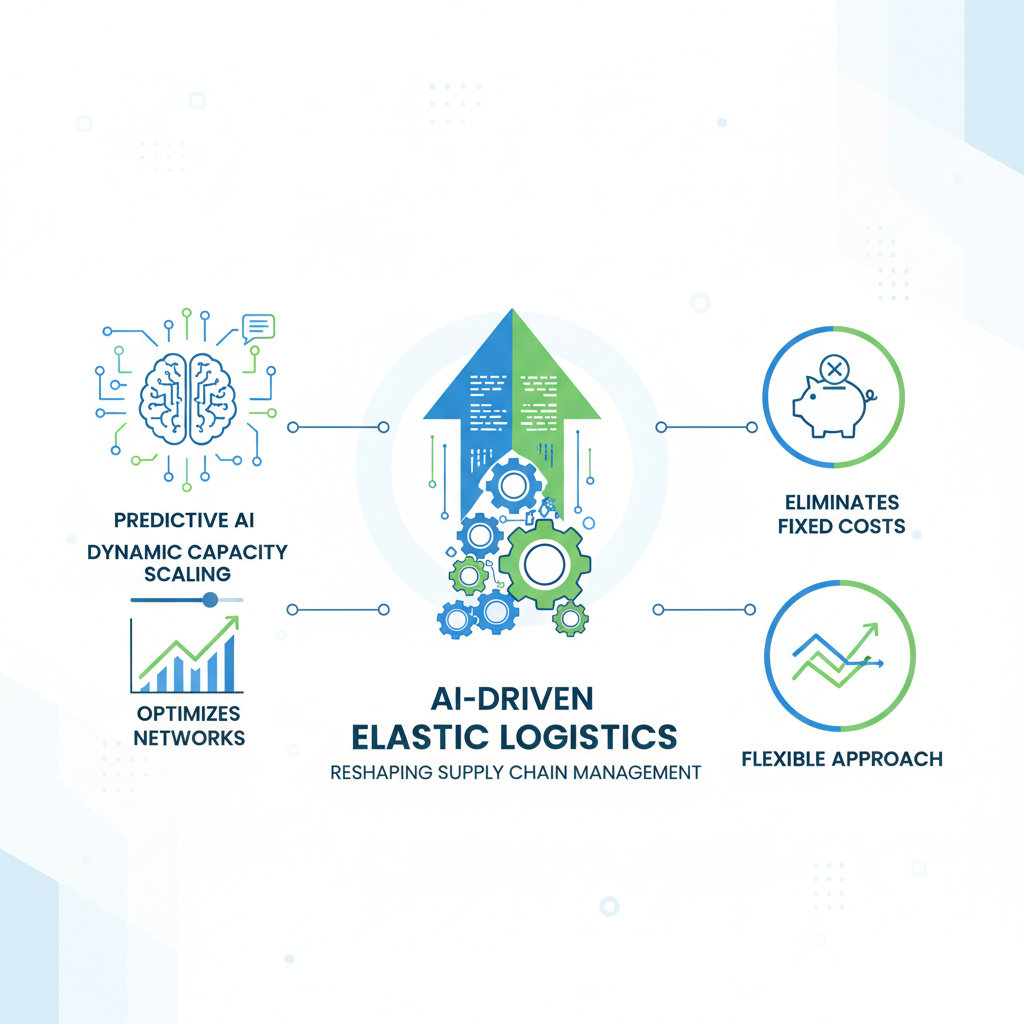
The global trade landscape is increasingly volatile, forcing supply chain executives to abandon rigid capacity models. In response, AI-driven elastic logistics has emerged as a transformative strategy for 2026, allowing operations to dynamically expand or contract based on real-time market signals. This approach shifts structural overhead from fixed capital expenditures to variable, pay-as-you-go frameworks, eliminating the financial drain of underutilized fleets and permanent warehousing.
Integrating artificial intelligence into elastic frameworks provides the predictive power necessary for seamless scaling. A 2026 report by The Business Research Company indicates that the global AI in logistics market reached $26.33 billion in 2025 and is projected to hit $180.63 billion by 2030, growing at a massive 47% CAGR [1]. Furthermore, a recent ABI Research survey reveals that 94% of supply chain organizations plan to deploy AI for decision support within two years [2].
Implementing an AI-driven elastic logistics model offers several competitive advantages for operators navigating complex regional infrastructures:
- Predictive Demand Forecasting: Machine learning algorithms analyze consumer behavior and seasonal trends to anticipate capacity requirements accurately.
- Dynamic Route Optimization: Real-time traffic, weather, and port congestion data automatically reroute shipments, mitigating delays and bottlenecks.
- Flexible Fulfillment Networks: Cloud-based orchestration enables the immediate integration of shared carrier networks and on-demand micro-fulfillment centers.
As the industry moves away from universal models toward specialized, autonomous operational agents, logistics service providers must build robust in-house data architecture. The companies poised for long-term profitability will transition from ad-hoc technological experimentation to structurally embedding AI-driven elastic logistics at the core of their network design.
References
[1] The Business Research Company: AI In Logistics Market Report 2026 (https://www.thebusinessresearchcompany.com)
[2] Open Sky Group / ABI Research: Supply Chain AI Statistics 2026 (https://www.openskygroup.com)