

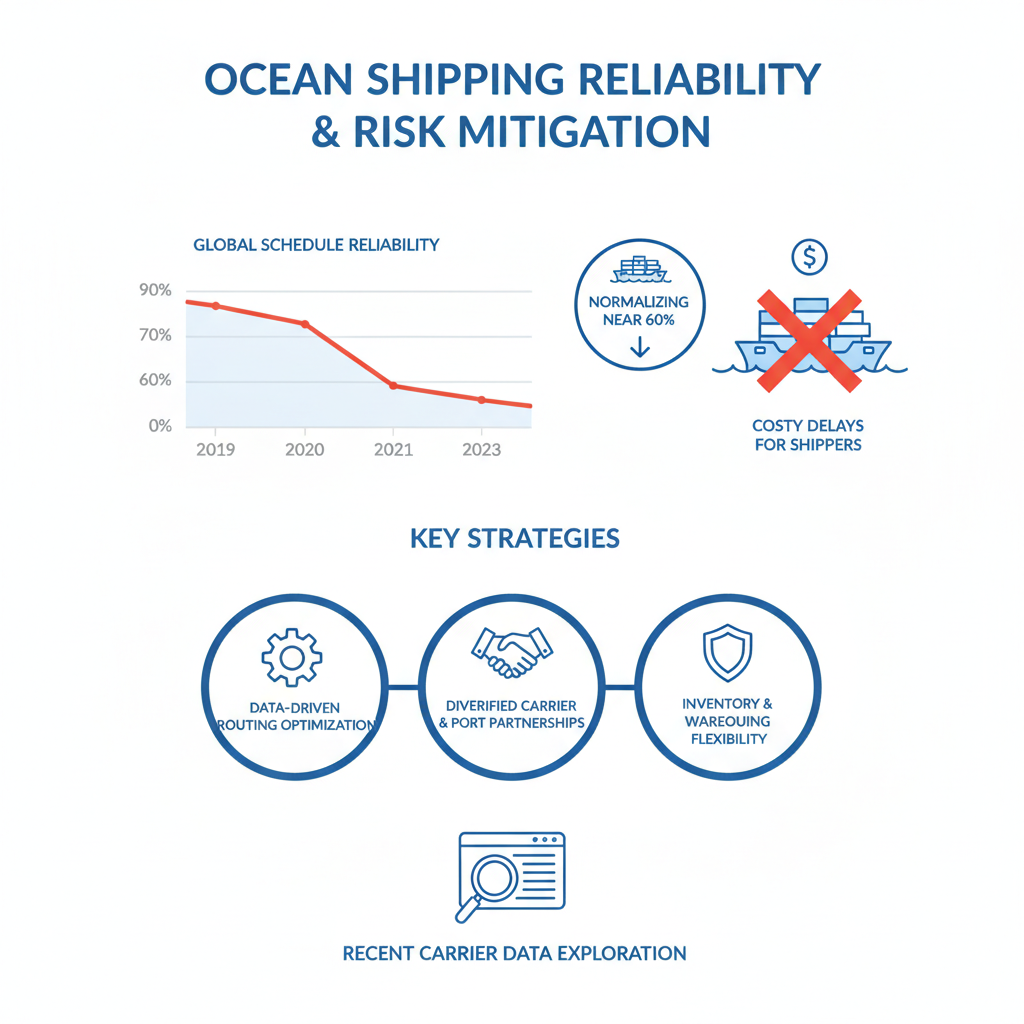
For logistics professionals navigating the post-pandemic supply chain, plunging ocean schedule reliability remains a critical bottleneck. According to recent Sea-Intelligence data, global schedule reliability languished between 50-55% throughout much of 2024 before marginally stabilizing at 62.8% by December 2025 [1]. While this represents a year-over-year improvement, performance is still drastically below the historical 70-80% reliability band that defined the market prior to 2020.
The latest operational statistics highlight a sharp bifurcation in carrier reliability. The newly formed Gemini Cooperation, comprising Maersk and Hapag-Lloyd, consistently outperforms the broader market [1]. In late 2025, Maersk and Hapag-Lloyd achieved reliability scores of 76.7% and 75.2% respectively [2]. Conversely, other major alliances continue to struggle, with many carriers trapped in the 50-60% bracket and the least reliable operators hovering around 47.8% [2].
This persistent volatility has profound financial ramifications for global supply chains. With the average delay for late vessel arrivals sitting persistently above 5 days [1], importers are forced to rethink their inventory strategies.
- Increased Buffer Stock: Shippers are carrying one to two weeks of additional inventory to absorb transit uncertainties.
- Revenue Leakage: Inconsistent arrivals lead to escalating demurrage and detention penalties.
- Siloed Visibility: Industry surveys report that while 64% of supply chain officers prioritize visibility, disconnected data limits financial risk mitigation [3].
To combat plunging ocean schedule reliability, experts recommend moving away from static planning. Shippers must integrate predictive ETAs, container-level data granularity, and agile forecasting into their core freight audit systems. As the industry normalizes lower service standards, prioritizing financial integration over traditional milestone updates is a mandatory survival strategy.
References
[1] Sea-Intelligence Global Liner Performance Report 2025/2026. [2] XENETA Schedule Reliability Scorecard 2025. [3] Deloitte Supply Chain Risk Mitigation Survey 2025.