

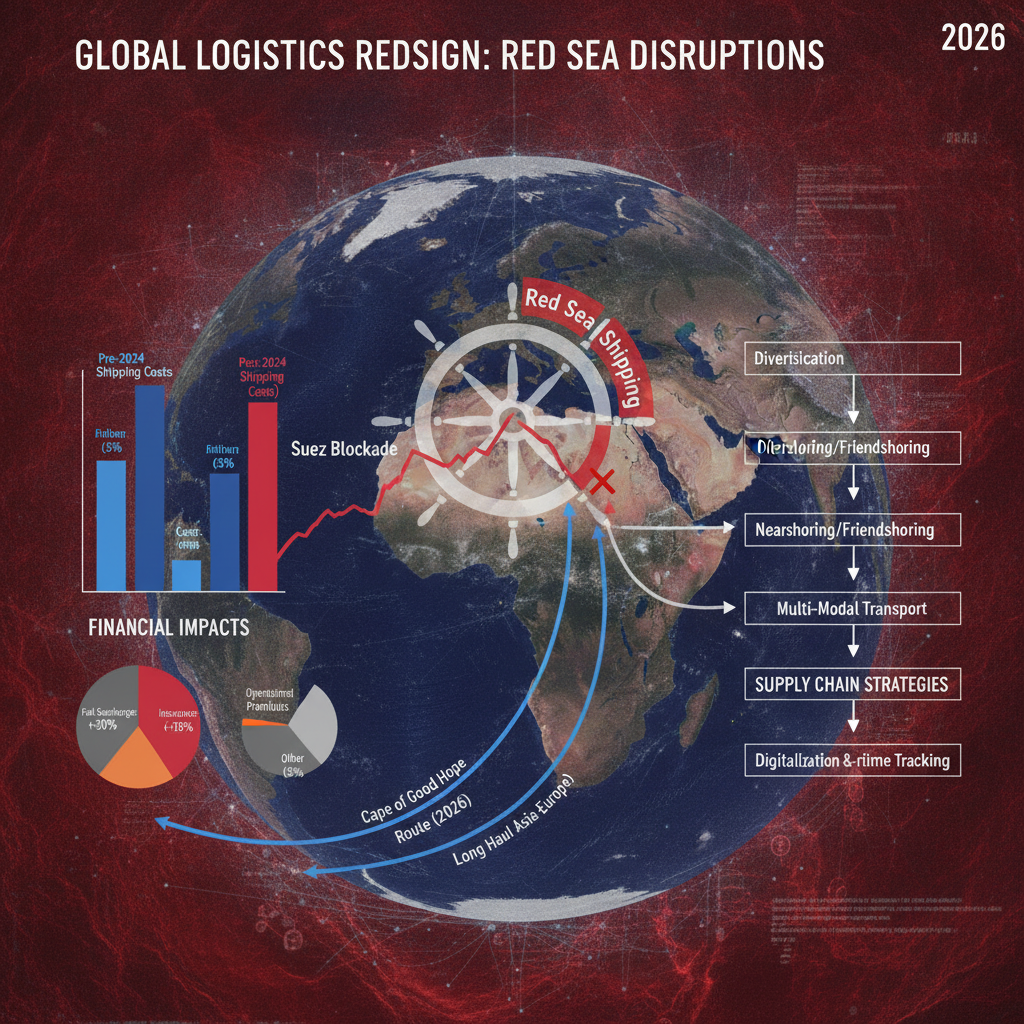
As we navigate through 2026, the ongoing Red Sea Shipping Disruptions have fundamentally reshaped global logistics. What began as temporary rerouting has become a structural shift in maritime trade, forcing logistics professionals to adopt long-term resilience strategies. With Houthi attacks persisting in the Bab el-Mandeb Strait, major carriers have cemented the Cape of Good Hope as the default routing for Asia-Europe and Asia-US East Coast lanes.
The financial and operational impacts of avoiding the Suez Canal remain severe for global supply chains. Recent market data indicates that Asia-Europe freight rates continue to run 25-40% higher than pre-crisis baselines. Operational metrics highlight the cascading effects on global trade:
- Transit times are extended by 10 to 15 days on average.
- Suez Canal container throughput experienced drops of up to 90% during peak volatility and remains depressed.
- Vessel war risk insurance premiums surged from 0.05% to 1.25%.
Supply chain leaders are transitioning from reactive crisis management to proactive strategic planning. The Red Sea Shipping Disruptions have underscored the critical vulnerability of maritime chokepoints. Experts emphasize that mitigating these systemic risks requires diversified supply routing, increased investments in nearshoring, and advanced digitalization for predictive risk forecasting. Until geopolitical stability returns to the region, building adaptive, multi-route logistics networks remains the only viable strategy for global shippers.
References
Suaid Global: Red Sea Shipping Crisis 2026: Impact on Your Supply Chain. FreightAmigo: How Geopolitical Factors Affect Red Sea Shipping Rates. Council on Foreign Relations: Conflict-Driven Chokepoint Disruptions. IRE Journals: The Impact of the Red Sea Crisis on Global Shipping and Strategic Supply Chain Management. DocShipper: Red Sea Crisis Update.