

How Ocean Carrier Blank Sailings Strategy Reshapes 2026 Trade
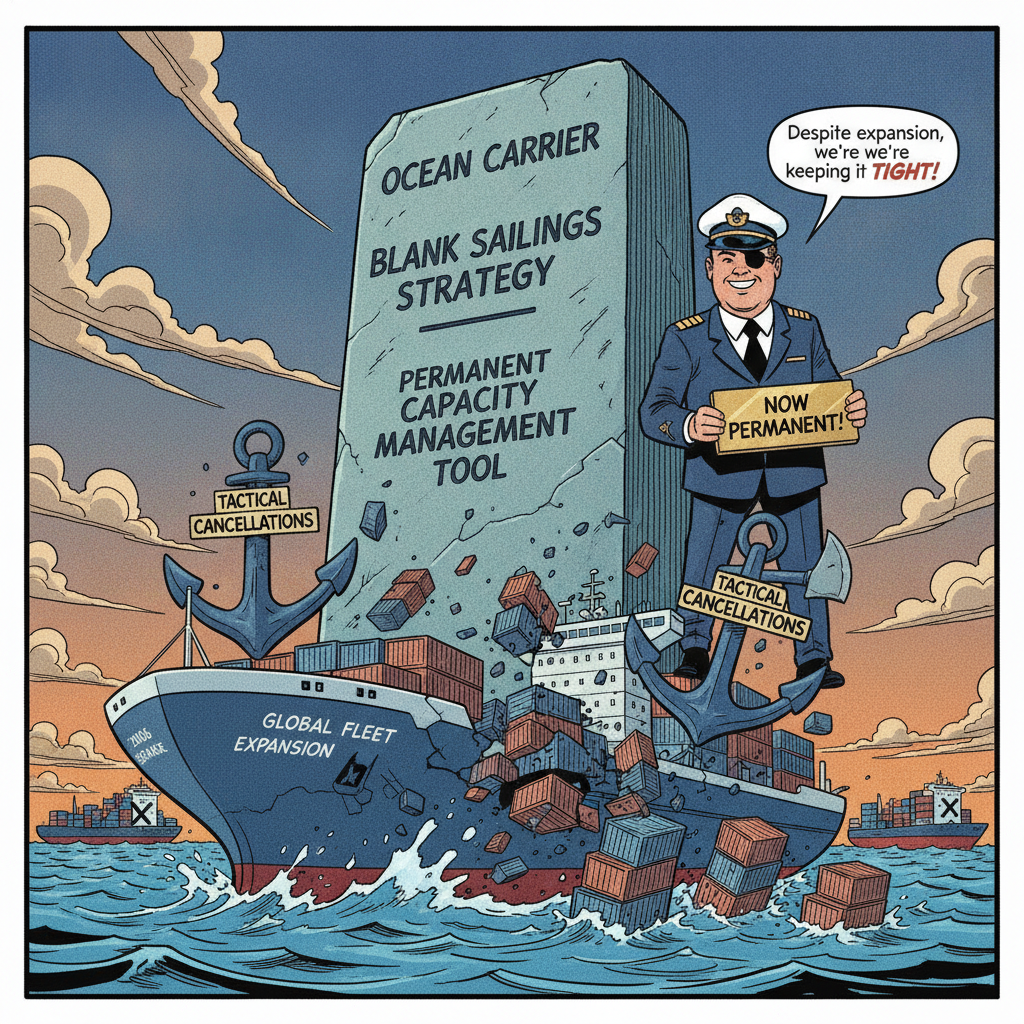
The global shipping landscape is undergoing a profound structural shift. While new container vessel deliveries continue to expand fleet sizes, the Ocean Carrier Blank Sailings Strategy has evolved from a short-term disruption response into a highly calibrated tool for capacity management. Rather than letting excess tonnage collapse spot rates, carriers are tactically withdrawing services to maintain market stability and pricing leverage.
Data Behind the Ocean Carrier Blank Sailings Strategy
Recent Sea-Intelligence data for the first half of 2026 reveals that carriers removed between 10% and 14% of scheduled capacity across four major east-west trade routes. This represents a stark increase from the 6% to 8% withdrawal rate observed in 2019. The Asia-North America East Coast trade exemplifies this phenomenon perfectly. Although scheduled capacity on this lane has grown by 46% since 2019, blanked capacity has skyrocketed by over 215%. According to Drewry’s Cancelled Sailings Tracker for late July 2026, an 8% cancellation rate was expected across major routes, with the Transpacific eastbound trade accounting for 60% of those disruptions.
Future Impacts of the Ocean Carrier Blank Sailings Strategy
This aggressive utilization of the Ocean Carrier Blank Sailings Strategy means that freight forwarders and shippers face tighter available space despite a larger global fleet. Alliance behaviors also vary significantly. For instance, the Gemini Cooperation recently demonstrated cancellation rates as low as 1% to 2.8%, contrasting with the 15% to 19.9% rates observed in the MSC and Ocean Alliances. Moving into the peak season, logistics professionals must pivot from relying on absolute capacity metrics to focusing on actual vessel availability and dynamic schedule adjustments.