

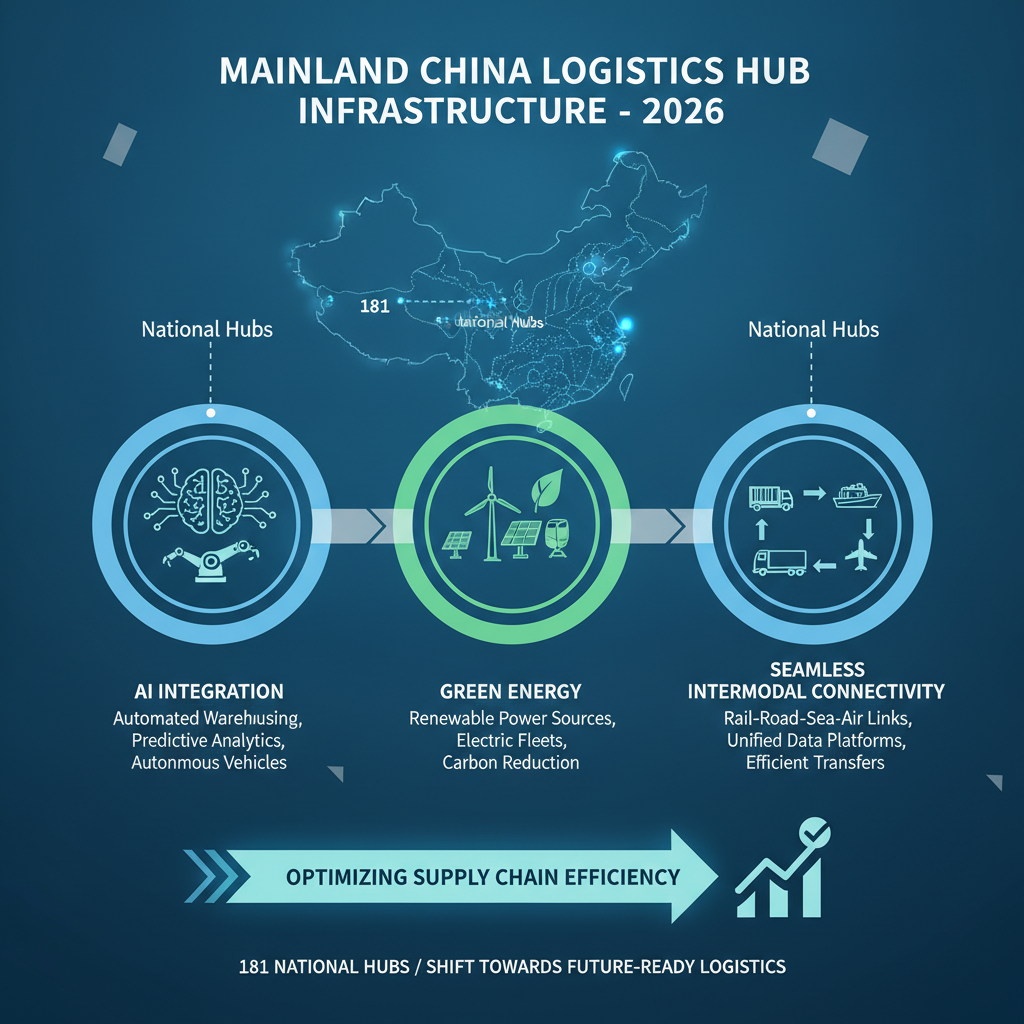
In 2026, Mainland China Logistics Hub Infrastructure has officially entered a transformative phase, pivoting from rapid expansion toward high-quality, tech-driven optimization. According to the China Federation of Logistics & Purchasing’s National Logistics Hub Innovative Development Report (2026), the average cargo throughput of China’s national logistics hubs grew by 5.5% year-on-year in 2025. As of mid-2026, the country has successfully designated 181 national hubs, fulfilling 79% of its overarching infrastructure plan. This maturation signifies a critical shift for global supply chain managers, prioritizing operational efficiency over sheer capacity growth.
Smart Upgrades in Mainland China Logistics Hub Infrastructure
Technological integration and sustainability are now the foundational pillars of Mainland China Logistics Hub Infrastructure. Recent data reveals that over 90% of national hubs have deployed smart equipment, while more than 70% utilize new-energy vehicles for internal and short-haul operations. Furthermore, as China transitions into its 15th Five-Year Plan (2026-2030), logistics developers are heavily leveraging artificial intelligence and big data platforms to optimize throughput. Savills’ 2026 China Logistics Real Estate Report underscores this trend, noting a strategic pivot toward renovating existing assets into high-standard, energy-efficient facilities.
Intermodal Reach of Mainland China Logistics Hub Infrastructure
Intermodal connectivity remains a distinct competitive advantage for Mainland China Logistics Hub Infrastructure. Nearly 80% of current hubs boast direct railway connections, integrating 97.2% of dry port hubs and 89.7% of seaport hubs into a seamless national grid. Consequently, rail freight train operations via these hubs surged by 7.4% year-on-year, cementing the infrastructure’s resilience against disruptions. For shipping experts, this extensive multimodal network directly translates to reduced inland transit times and significantly lower total logistics costs.