

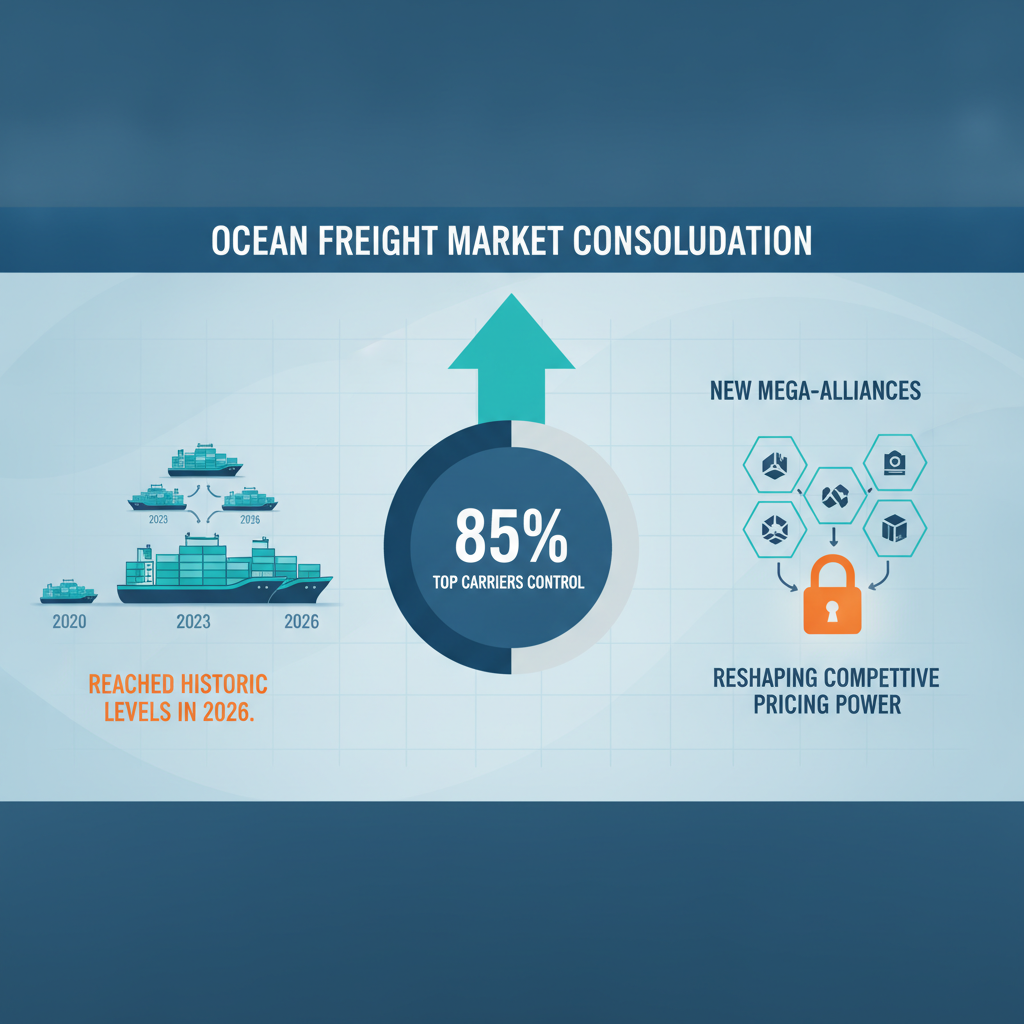
Ocean Freight Market Consolidation: Unprecedented Control in 2026
The global shipping industry is experiencing a historic era of Ocean Freight Market Consolidation, fundamentally altering how capacity and pricing are managed. As of mid-2026, the top 10 ocean carriers control an astonishing 85% of global container capacity. Leading the charge is Mediterranean Shipping Company (MSC), which recently became the first carrier in history to surpass a 20% market share, reaching 21.5% of the total global fleet. This concentration of power leaves shippers with fewer independent options but potentially more streamlined service networks.
How Ocean Freight Market Consolidation Drives Mega-Alliances
Recent structural shifts have reshaped the competitive landscape. The February 2025 alliance reshuffle split the dominant carriers into powerful groups like the Gemini Cooperation (Maersk and Hapag-Lloyd) and the Premier Alliance. Furthermore, Hapag-Lloyd’s early 2026 agreement to acquire ZIM for $4 billion solidified its position as a top-five operator with over 3 million TEUs in capacity. These consolidation strategies allow carriers to exert significant influence over sailing schedules and pricing power.
- Strategic Groupings: Alliances coordinate transatlantic and transpacific capacity to stabilize rates.
- Fleet Dominance: The top four carriers alone now hold more than half of all TEU at sea.
- Shipper Response: Beneficial cargo owners are aggregating volumes to secure multi-year contracts.
Navigating Capacity Surges Amidst Ocean Freight Market Consolidation
Despite heavy market consolidation, the ocean freight sector faces a massive capacity influx in 2026. Approximately 1.5 million TEUs of excess capacity are expected to hit the water, outpacing the projected 3% demand growth. For logistics experts, this creates a unique negotiating environment. While consolidated carriers attempt to tightly manage vessel deployment to prevent rate collapses, the structural overcapacity gives well-prepared shippers leverage to secure critical discounts for long-term commitments.
References
- Transatlantic Ocean Freight: Carrier Strategies (October 2025)
- Transatlantic Ocean Freight: Rate Volatility (October 2025)
- Transatlantic Ocean Freight: Europe-US Routes (October 2025)
- Top 10 Largest Ocean Carriers 2026 by TEU Capacity (July 2026)
- Hapag-Lloyd-ZIM Mega Acquisition Deal Shakes Up Container Market (March 2026)
- Ocean Freight Rate Negotiations 2026: How to Win (February 2026)
- Container Shipping Consolidation Continues – CLECAT (June 2026)