

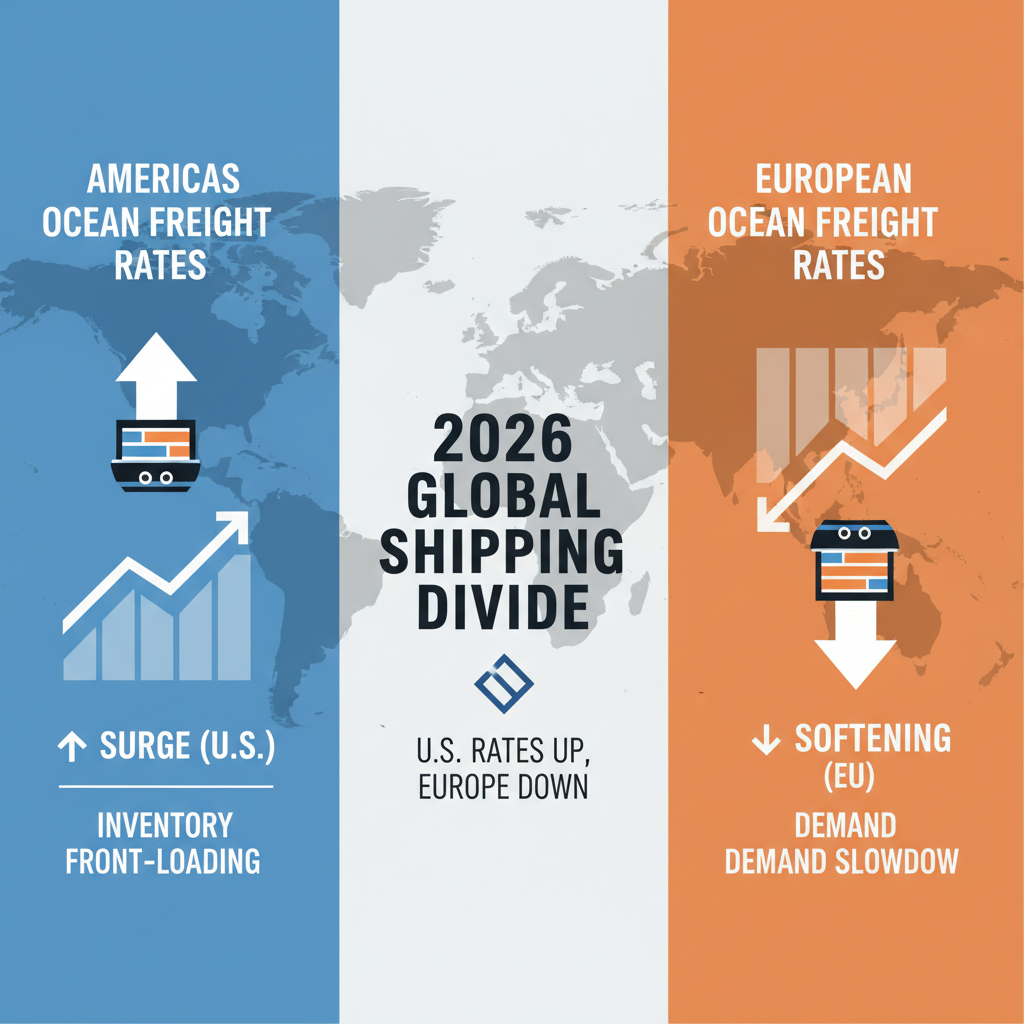
In 2026, the Americas and Europe ocean freight rate divergence has become a defining trend for global supply chains. Spot rates on Asia-U.S. trade lanes remain unexpectedly resilient. Recently, Asia-U.S. West Coast prices reached $2,828 per FEU, while East Coast prices hit $4,340 per FEU. Conversely, Asia-Europe pricing has softened, primarily supported by carrier capacity manipulation rather than raw demand. This Americas and Europe ocean freight rate divergence forces logistics experts to rethink global contracting strategies.
The divided 2026 market stems from distinct regional pressures. While both corridors face geopolitical disruptions, their operational dynamics differ radically:
- Strategic Front-Loading: Americas importers are aggressively front-loading inventory to mitigate risks from U.S. tariff shifts and port labor tensions.
- Capacity Management: Ocean carriers are heavily utilizing blank sailings to artificially support trans-Pacific rates.
- Transatlantic Shifts: Container capacity from Northern Europe to the U.S. East Coast recently hit a 28-month high of 60,000 TEU, stabilizing regional pricing.
Adapting to the Americas and Europe ocean freight rate divergence requires highly agile contract management. Carriers are attempting to restore margins through capacity reductions and early peak season surcharges. European routes remain heavily susceptible to sudden rate spikes from Middle East conflicts, while the Americas face continued volume pressures from e-commerce shifts and early inventory positioning.
References
- Freightos: Trans-Pacific ocean rates remain above pre-war levels
- Metro Global: Peak season uncertainty grows as freight demand diverges
- Doma Shipping: USA Europe Container Rates Surge 26% in 2026
- Freightos: What 2025 Means for 2026 Ocean and Air Freight Forecast