

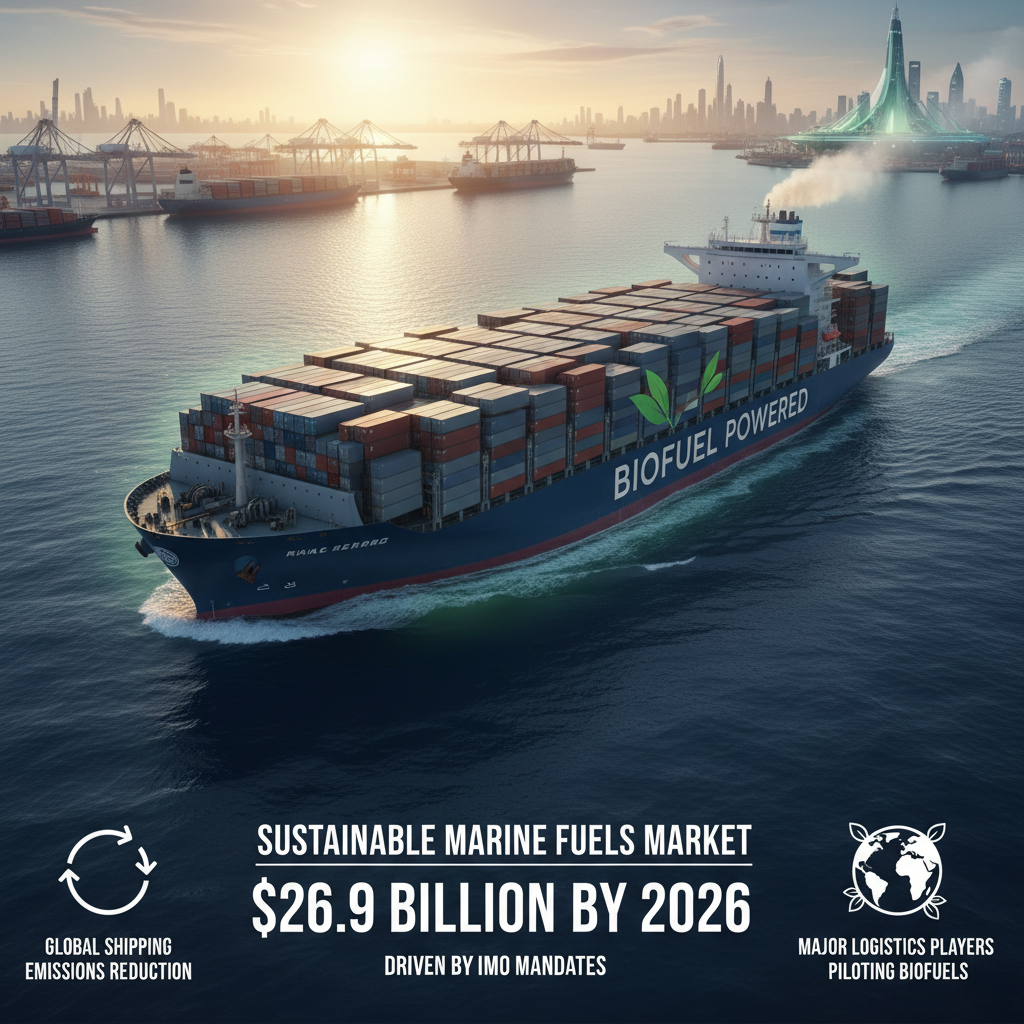
The global logistics and shipping industry is undergoing a massive transformation in 2026. Emitting over 920 million tonnes of CO2 annually, the maritime sector is under immense pressure to decarbonize. As a result, the market for Sustainable marine fuels is experiencing unprecedented growth, with recent 2026 valuations placing the industry between USD 18.9 billion and 26.93 billion. Experts project a staggering compound annual growth rate of over 47%, driven by stringent International Maritime Organization (IMO) mandates and European regulatory frameworks.
Key logistics players are actively moving from conceptual goals to operational realities. In a landmark May 2026 development, shipping heavyweights Hapag-Lloyd and Kuehne+Nagel launched their first collaborative pilot utilizing Sustainable marine fuels for ocean freight. This initiative leverages roughly 1,000 tonnes of RED III compliant, waste-based biofuel to avoid nearly 3,000 tonnes of CO2 equivalent emissions. Real-world applications like this are critical, as they enable verifiable scope 3 emission reductions for end-customers on major trade routes such as the East Asia to North Europe lane.
The integration of Sustainable marine fuels is no longer just an environmental imperative; it is a core business strategy. The transition requires substantial capital, with green ammonia projects demanding upwards of 1 billion euros for production facilities. To succeed, logistics experts must navigate several key factors:
- Scaling the production of advanced biofuels, methanol, and hydrogen-based e-fuels.
- Retrofitting vessels with dual-fuel engines capable of running on low-sulfur alternatives to cut well-to-wake greenhouse gases.
- Establishing robust book-and-claim supply chains to transparently commercialize emission reductions.
Ultimately, successfully sourcing and deploying these next-generation energy solutions will dictate the market leaders in tomorrow’s decarbonized global supply chain.
References
Research Nester: Sustainable Marine Fuels Market Size, Growth Trends 2035 (URL: https://www.researchnester.com/) | Port of Rotterdam: Creating Insights to Sustainable Marine Fuels (URL: https://www.portofrotterdam.com/) | Kuehne+Nagel: Joint step towards sustainable ocean shipping (URL: https://newsroom.kuehne-nagel.com/)