

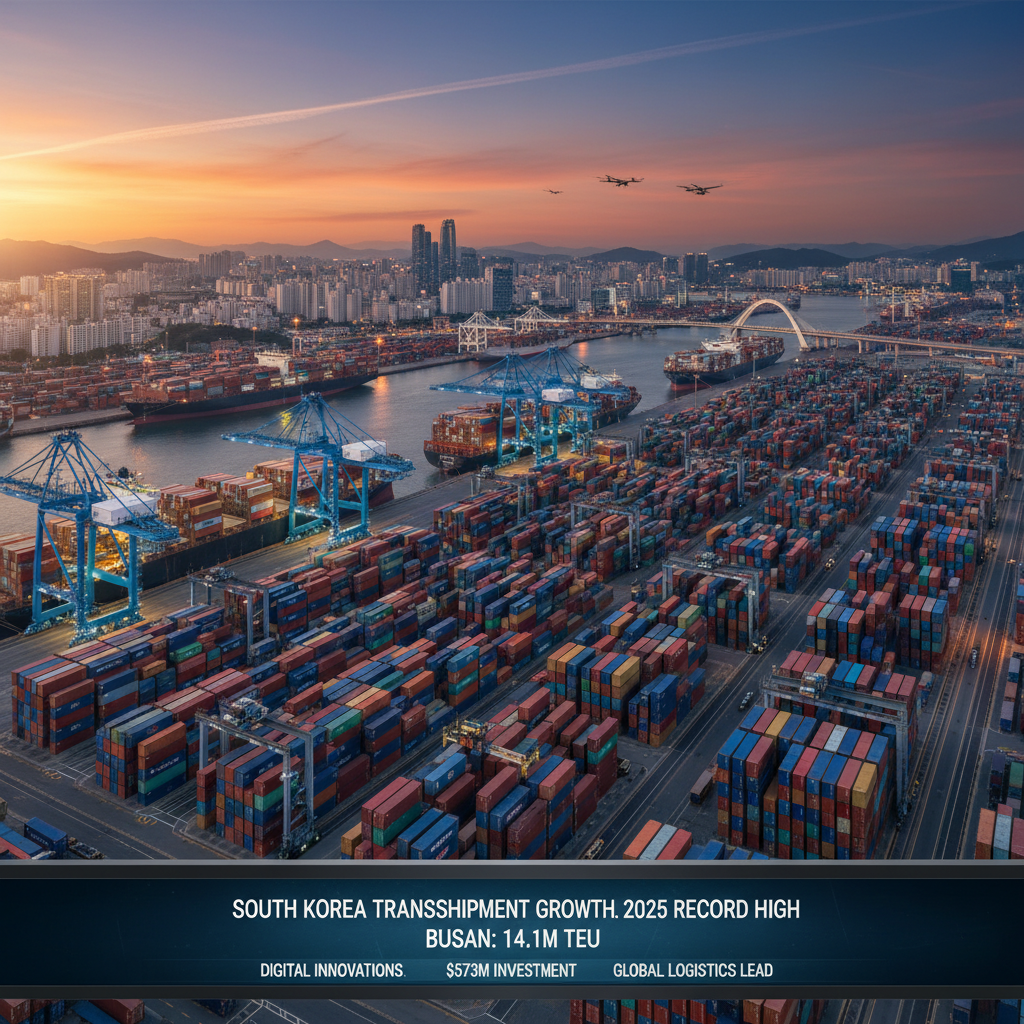
Despite global trade uncertainties, South Korea remains a premier logistics hub. In 2025, the nation demonstrated remarkable resilience, propelled by record container throughput at Busan Port. As regional competitors expand, South Korea transshipment growth remains the linchpin of its maritime strategy, driven by infrastructural investments and digital transformation.
Busan Port achieved a historic milestone in 2025, handling 24.88 million TEU, a 2.0% year-on-year increase. The catalyst was the transshipment sector. Key performance indicators include:
- Transshipment volume surged by 4.4% to reach 14.1 million TEU.
- This segment accounts for 57% of total cargo volume.
- Foreign carriers handled 80% of these volumes, cementing Busan as the world’s second-largest transshipment hub.
This growth is attributed to digital innovations like the Transshipment Shuttle System (TSS) and Port-i platform. These AI systems reduced truck wait times and improved transfer efficiency, prompting the Gemini Alliance to route North China cargo through Busan.
To sustain momentum, the government committed $573 million to develop a new feeder terminal by 2030, adding 1.5 million TEUs in capacity. However, experts caution that infrastructural expansion must be paired with a maritime finance cluster to fend off rivals like Tanjung Pelepas. By integrating smart ports and finance, South Korea aims to secure its maritime dominance.
References
- Busan Cargo Handling Growth Report
- South Korea $573M Feeder Terminal Investment
- Busan Port Authority 2025 Reports
- Integrated Port Ecosystem Needs
- Busan Port 2025 Record Throughput
- Global Transshipment Rankings