
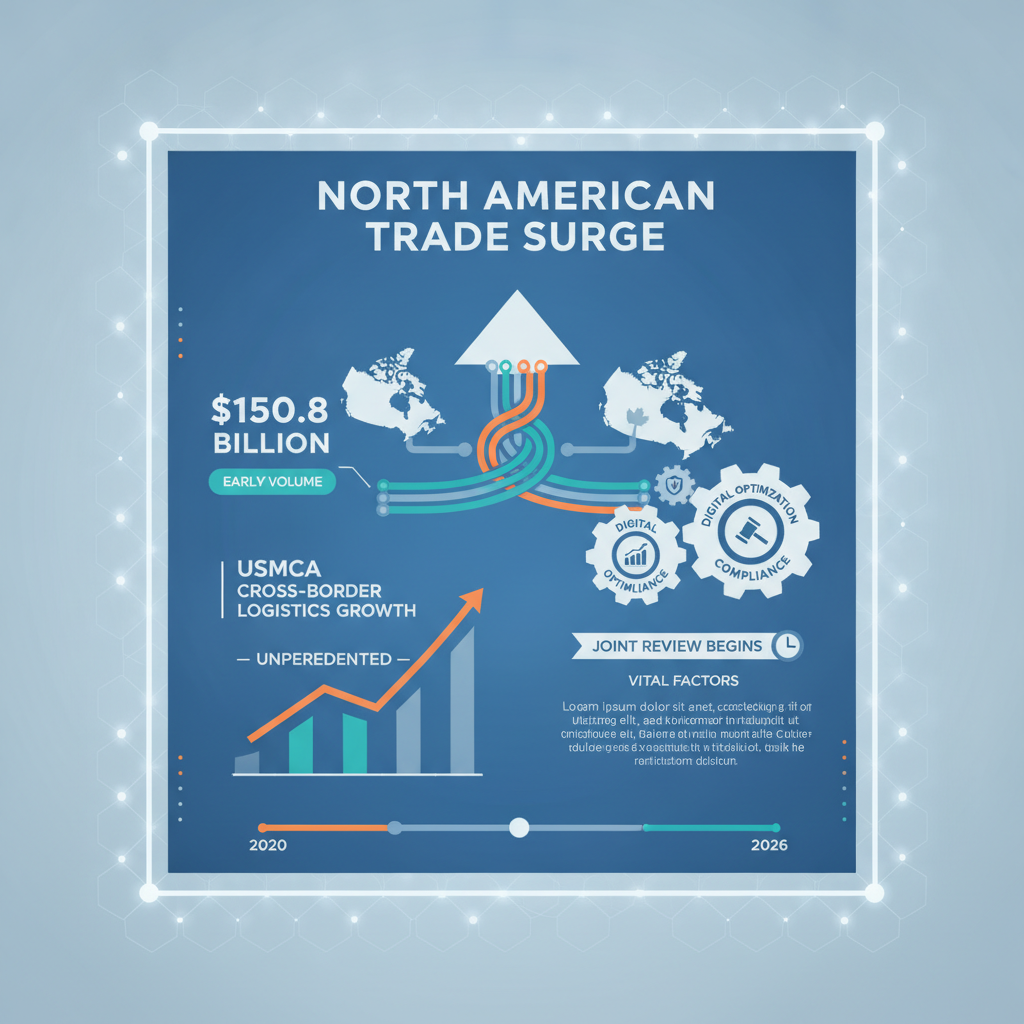
As policymakers convene for the pivotal July 2026 USMCA Joint Review, North American trade networks are experiencing unprecedented volume. In April 2026, total cross-border freight between the United States, Mexico, and Canada reached US$150.8 billion, representing a massive 19.4% year-over-year increase. For logistics experts managing USMCA Cross-Border Logistics, this environment demands a strategic pivot toward digital optimization and stringent tariff compliance.
Nearshoring initiatives have heavily influenced recent trade expansions, particularly impacting U.S.-Mexico supply lanes. Trade with Mexico alone totaled US$86 billion in April 2026, while U.S.-Canada freight reached US$64.8 billion. To handle these intense volumes, regional operators are heavily adapting their operational frameworks.
- Trucking Dominance: Road freight remains the backbone of the system, moving US$98.4 billion in April 2026, an 18.8% increase from 2025.
- Air Cargo Acceleration: Time-sensitive nearshoring operations drove air freight up by 66.2% year-over-year to US$8 billion.
- Compliance Pressures: By early 2026, USMCA exemption claim rates on imports surged to 86.3%, up from 45% in late 2024, proving that rigorous compliance is now a baseline survival tactic.
Industry leaders are integrating artificial intelligence routing and automated compliance documentation to counter persistent border bottlenecks at key gateways like Laredo and Otay Mesa. With USMCA Cross-Border Logistics anchoring a multi-billion dollar continental economy, stakeholders must treat compliance and digital visibility not as secondary functions, but as core drivers of operational resilience.
References
US Department of Transportation Bureau of Transportation Statistics, July 2026 Data. Tradlinx, May 2026 Report. FreightAmigo, August 2025 Analysis. DOT Operating Authority, July 2026 Review.