

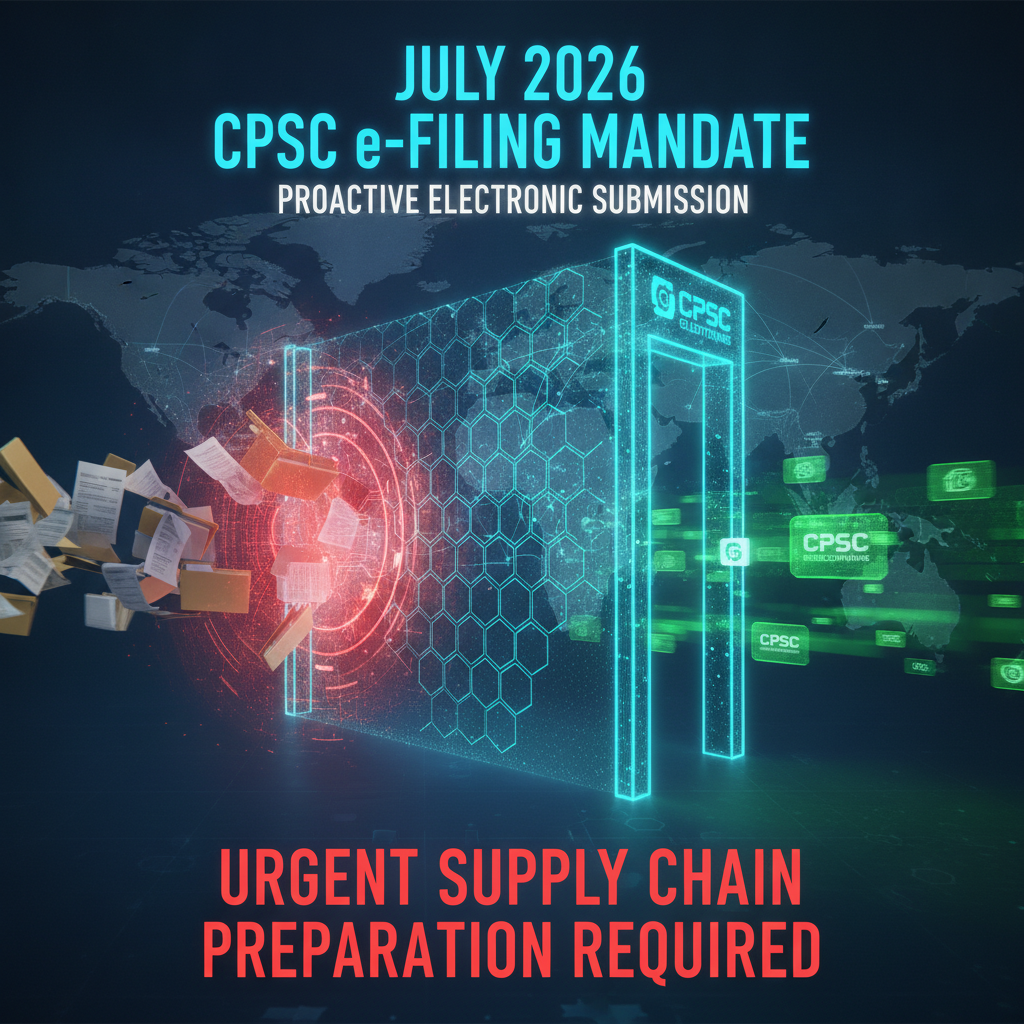
The Dawn of CPSC e-Filing Customs Compliance
Starting July 8, 2026, the U.S. Consumer Product Safety Commission (CPSC) will permanently alter how regulated consumer products enter the United States. The new CPSC e-Filing Customs Compliance mandate requires shippers and logistics providers to electronically submit General Certificate of Conformity (GCC) and Children’s Product Certificate (CPC) data at the precise time of entry. This regulatory shift officially ends the decades-old practice of simply keeping paper certificates on file to be produced only upon regulatory request.
Navigating CPSC e-Filing Customs Compliance Deadlines
The updated regulation impacts approximately 600 Harmonized Tariff Schedule (HTS) classifications. Importers are now mandated to transmit safety data directly into U.S. Customs and Border Protection’s Automated Commercial Environment (ACE) system using a PGA Message Set. While the primary rollout affects standard consumption entries in July 2026, a secondary compliance phase for goods entering through Foreign Trade Zones (FTZs) will take effect on January 8, 2027. Furthermore, there is no de minimis value exemption, meaning shipments of all values are strictly regulated.
Strategic Preparation for Logistics Experts
Failing to adapt to these stringent protocols risks severe supply chain disruptions, including denied entry, costly port delays, and substantial fines. To ensure seamless border operations, logistics professionals must take proactive steps:
- Audit your entire product portfolio against the CPSC’s flagged HTS codes immediately.
- Preload certification documents into the newly established CPSC Product Registry to generate reference identifiers and accelerate customs clearance.
- Coordinate IT and compliance integration with your customs brokers long before the July 2026 deadline.