

Why Global Supply Chain Nearshoring is Accelerating in 2026
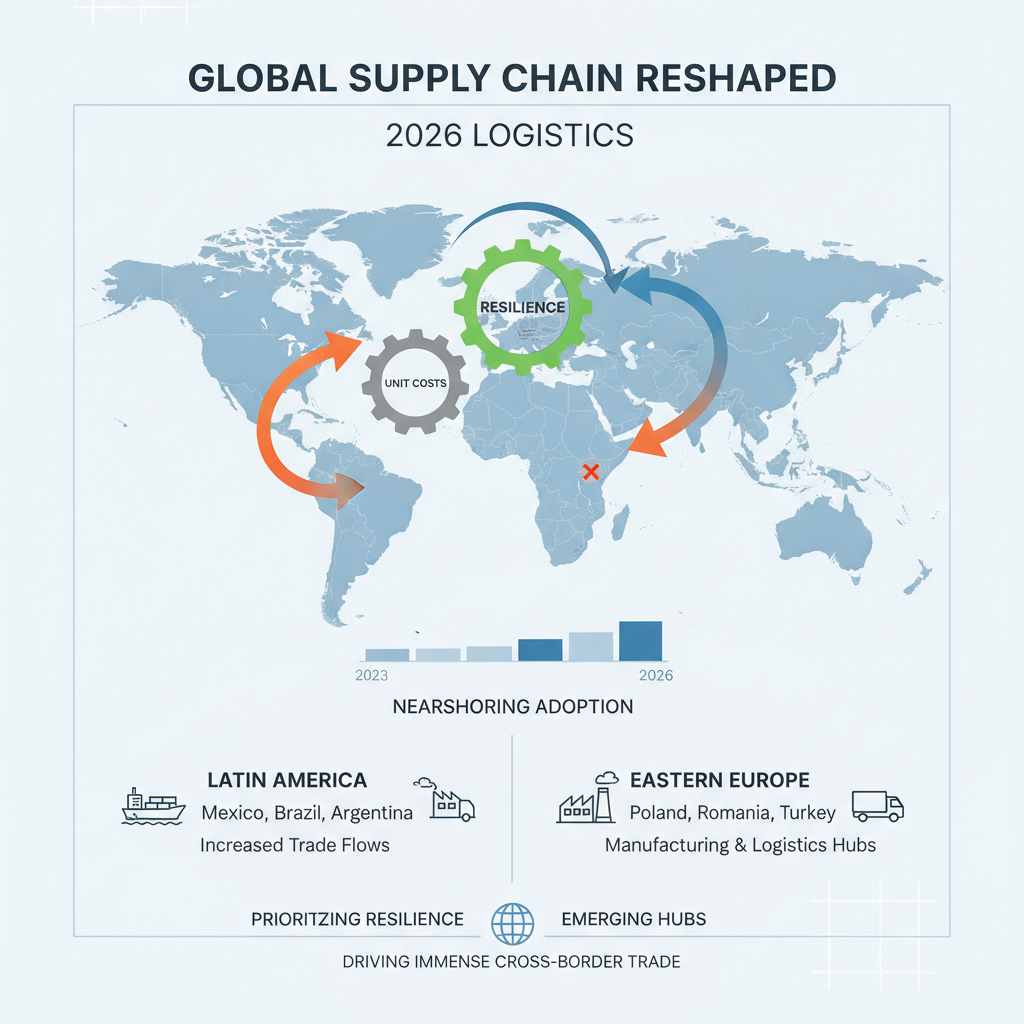
In 2026, the logistics sector is shifting from temporary crisis management to structural realignment. Global supply chain nearshoring has transitioned into a critical operational blueprint for multinational corporations. Driven by geopolitical fragmentation, industry experts note that nearshoring is actively reshaping global trade routes. Recent market reports project the nearshoring market to expand at a 10% compound annual growth rate through 2028. This growth highlights how businesses are prioritizing resilience over unit-cost optimization.
Regional Growth: Latin America and Central-Eastern Europe
New capacity hotspots are rapidly emerging as global supply chain nearshoring takes root. In Europe, despite a 7% drop in overall foreign direct investment in 2025, Central and Eastern Europe experienced a nearshoring surge. A recent industry survey indicated that 76% of European businesses faced severe delays, prompting many to explore nearby sourcing locations like Poland and Romania.
Simultaneously, the Americas are undergoing a logistical transformation. Market updates indicate that manufacturing shifts toward Mexico and Latin America are driving immense cross-border trade. This momentum is generating lucrative opportunities for multimodal transportation and integrated warehousing.
The Future of Global Supply Chain Nearshoring
As 2026 progresses, the logistics industry must adapt to decentralized networks. The evolution of global supply chain nearshoring is no longer a temporary adjustment, but the permanent architecture of global commerce.
References
- Global Capital Trends: European FDI Resilience (Aug 2026)
- FreightPulse: Impact of Nearshoring (Apr 2026)
- Maersk Latin America Market Update (Sep 2026)
- nShift: 2026 Delivery Trends (Dec 2025)