

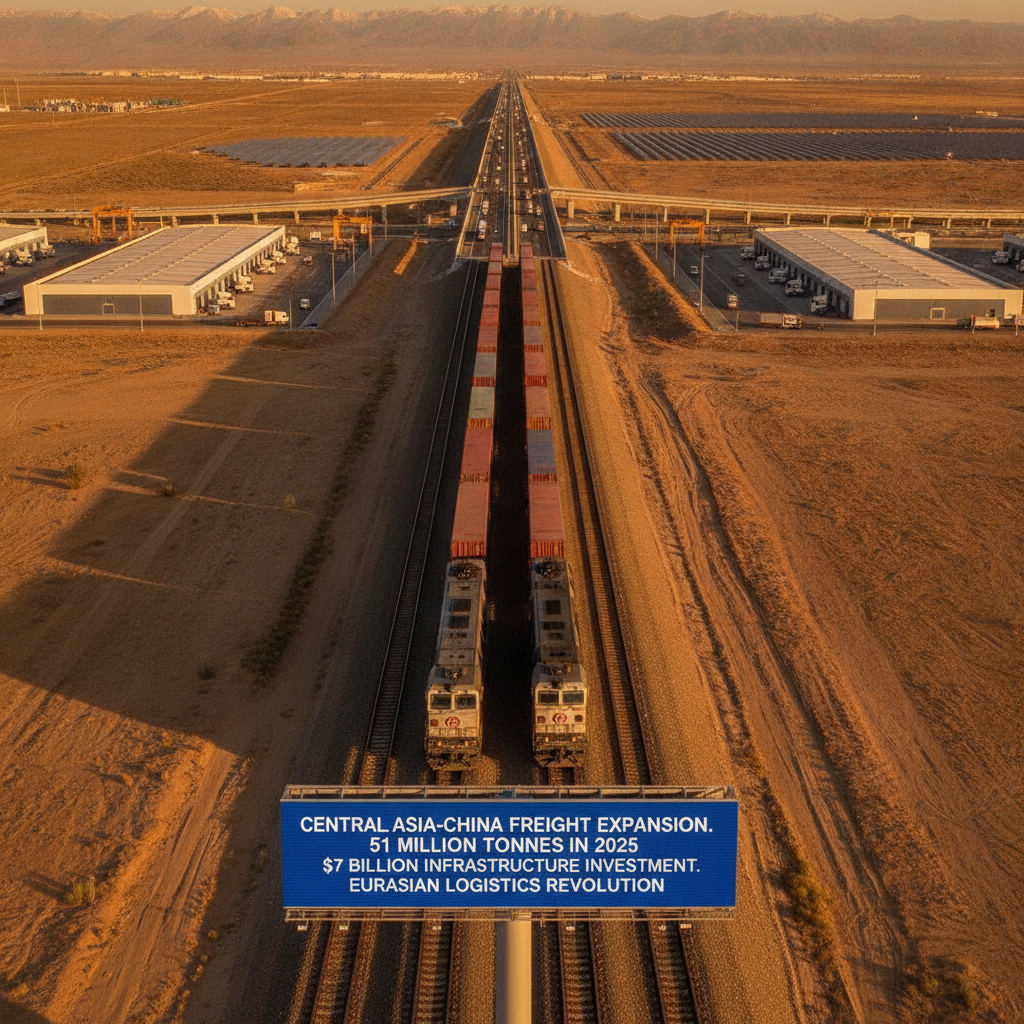
The Rapid Central Asia-China Freight Expansion
The global logistics landscape is undergoing a major transformation as Central Asia-China freight expansion accelerates at an unprecedented pace. Driven by surging bilateral trade and massive infrastructure investments, this Eurasian land bridge offers highly competitive alternatives to traditional maritime shipping.
Central Asia-China Freight Expansion: Surging Volumes
According to a November 2026 report by the Eurasian Development Bank (EDB), freight volumes have reached historic milestones. Key statistical insights include:
- Total rail and road freight hit a record 51 million tonnes in 2025.
- Rail transport accounted for 35.6 million tonnes, while road freight reached 15.4 million tonnes.
- Freight volumes increased by 8% year-over-year during the first ten months of 2026.
- Regional trade turnover nearly tripled to $70 billion between 2020 and 2025.
Consequently, China now stands as the region’s largest trading partner, managing nearly 30% of its total trade.
Infrastructure Backing Central Asia-China Freight Expansion
To support this Central Asia-China freight expansion, multi-billion-dollar infrastructure upgrades are actively being deployed. Kazakhstan currently processes 84% of all land transport flows between the two regions. To mitigate transit bottlenecks, Chinese commitments to regional transport infrastructure have reached $7 billion. Furthermore, container transit via Central Asia exceeded 351,000 TEUs in 2025, highlighting the corridor’s capacity for high-value operations. For logistics and shipping experts, these investments signify a more resilient supply chain network across Eurasia.
References
UzDaily, “Central Asia-China Freight Reaches 51 Million Tonnes”, Nov 19, 2026.
Logistics Great, “Decoding the Central Asia-China Land Freight Expansion Boom in 2026”, Nov 21, 2026.
Eurasian Development Bank, “Analytical Brief on Transport Links”, Nov 19, 2026.