

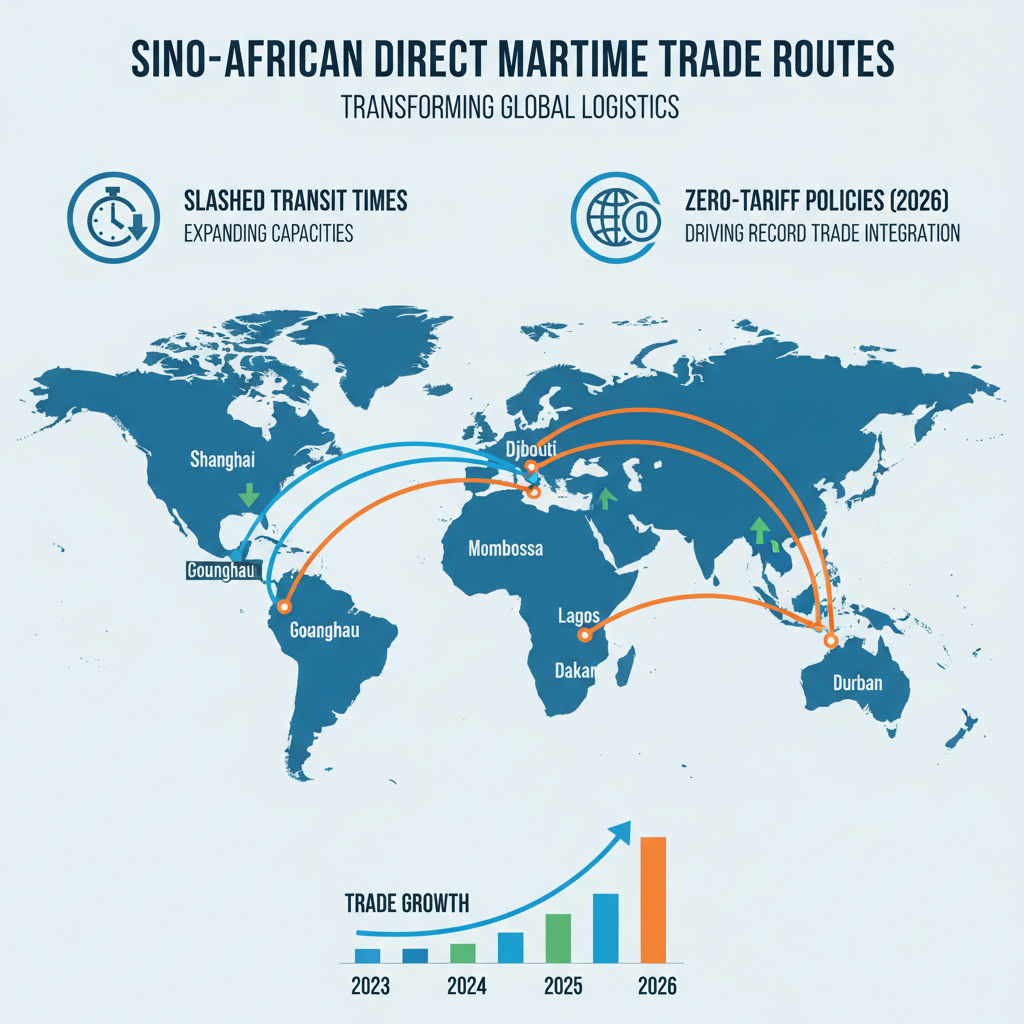
As global supply chains undergo rapid restructuring, Sino-African direct maritime trade routes are emerging as a pivotal force in international shipping. Recent expansions in vessel deployments are fundamentally altering transit predictability and capacity allocations. In 2025, container carriers increased their capacity on the Asia-Africa lane by an unprecedented 27.3% to accommodate surging volumes [1]. This structural shift is driven by deep trade integration, culminating in bilateral trade that reached a record $348 billion in 2025, marking a 17.7% year-over-year increase [2].
In preparation for China’s zero-tariff policy for 53 African nations effective May 1, 2026, major Chinese ports have upgraded direct container services [3]. Port efficiency metrics reflect this rapid transformation:
- Tianjin port introduced direct services to South Africa, slashing transit times by 10 days to approximately 40 days [4].
- Yantai’s cargo volumes on these targeted routes surged over 30% in the first quarter of 2026, surpassing 2 million tonnes [5].
- Exports from Qingdao to African destinations exceeded $6.37 billion in Q1 2026 alone, highlighting sustained demand for industrial goods [3].
The strategic value of these maritime corridors extends far beyond coastal hubs. Operators are increasingly adopting a port-rail-industrial park model to maximize efficiency. By linking deep-sea terminals like Nigeria’s Lekki Port with inland networks such as the Lobito Corridor, forwarders offer seamless supply chain solutions [6]. Consequently, shipping costs across Sino-African corridors are dropping, solidifying a logistical ecosystem built for long-term scalability.
References
[1] cargonow.world
[2] italianelfuturo.com
[3] globaltimes.cn
[4] businessinsider.com
[5] tvbrics.com
[6] italianelfuturo.com