

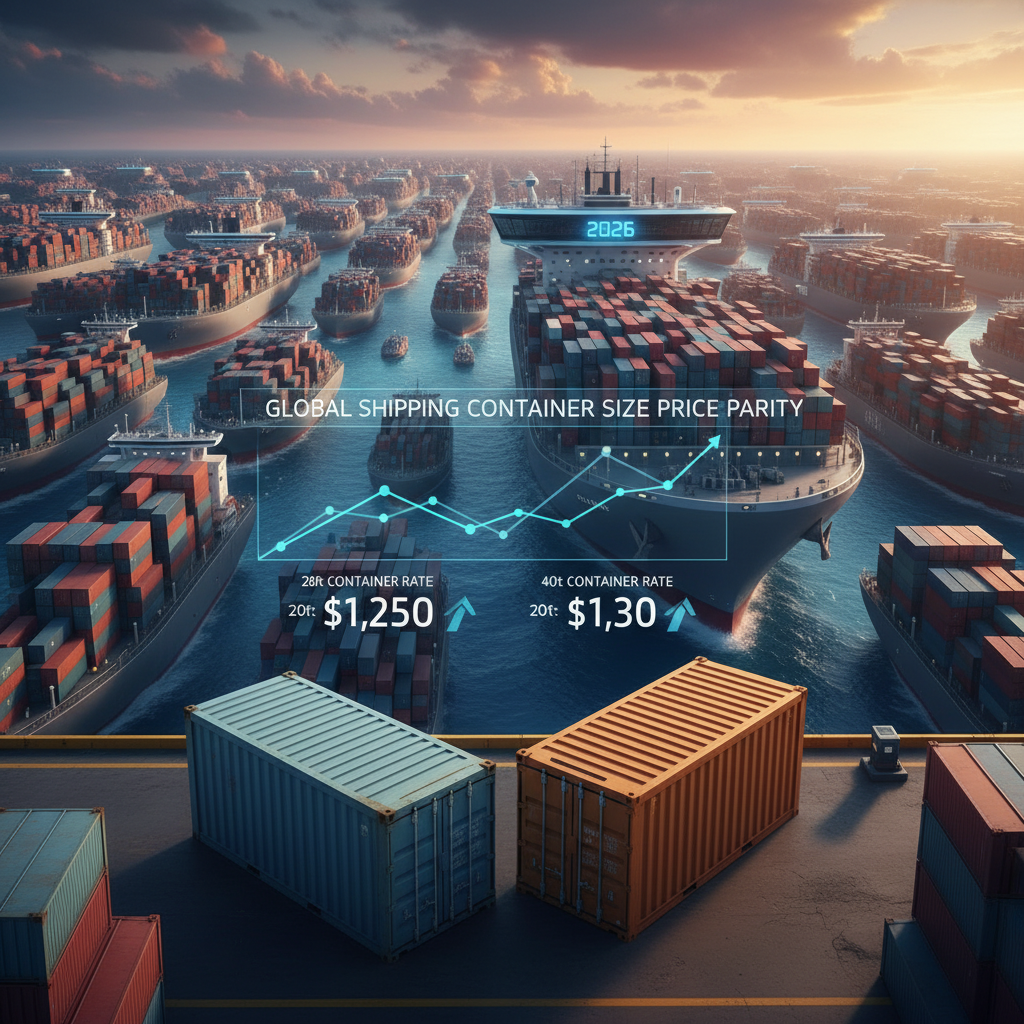
As the logistics industry adapts to 2026, Global shipping container size price parity is undergoing a significant transformation. Traditionally, the ocean freight rate difference between 20-foot (TEU) and 40-foot (FEU) units offered distinct cost advantages per cubic meter for larger shipments. However, fleet capacity changes are rewriting historical pricing dynamics.
The primary driver altering Global shipping container size price parity is an unprecedented wave of new vessel capacity. By 2026, the global fleet will grow by 1.4 million TEU, adding significant market supply. This influx places downward pressure on base rates, narrowing the traditional margin gaps between TEU and FEU pricing. Furthermore, older vessels are not being rapidly decommissioned, causing a structural supply glut.
Variables currently dictating the cost-effectiveness of 20-foot versus 40-foot containers include:
- Spot Rate Volatility: Transpacific spot rates for an FEU dipped near $1,460 in late 2025 before rebounding to roughly $2,600 by mid-2026.
- Purchase Market Shifts: Used 20ft containers average $1,500 to $3,000, while used 40ft units sit closely between $2,000 and $4,500.
- Route-Specific Demand: Asia-to-Europe routes maintain resilient demand, with spot rates around $3,427 per 40ft container.
To capitalize on evolving Global shipping container size price parity, logistics experts must rethink their volumetric strategies. With the price delta shifting, shippers should secure hybrid contracts to balance long-term stability with short-term spot market flexibility.
References
- UFL Group – As 2025 ends, container rates increase
- Freightos – Container Shipping Overcapacity Outlook 2026
- SeaRates – 5 Key Factors of Container Costs
- Container xChange – Shipping container cost guide
- Lloyd’s List – The rise and fall of container spot rates
- YES Containers – Asia-Europe Shipping Rates
- SunSirs – 2026 Container Shipping Market Dynamics
- 2026 Ocean Freight Outlook