

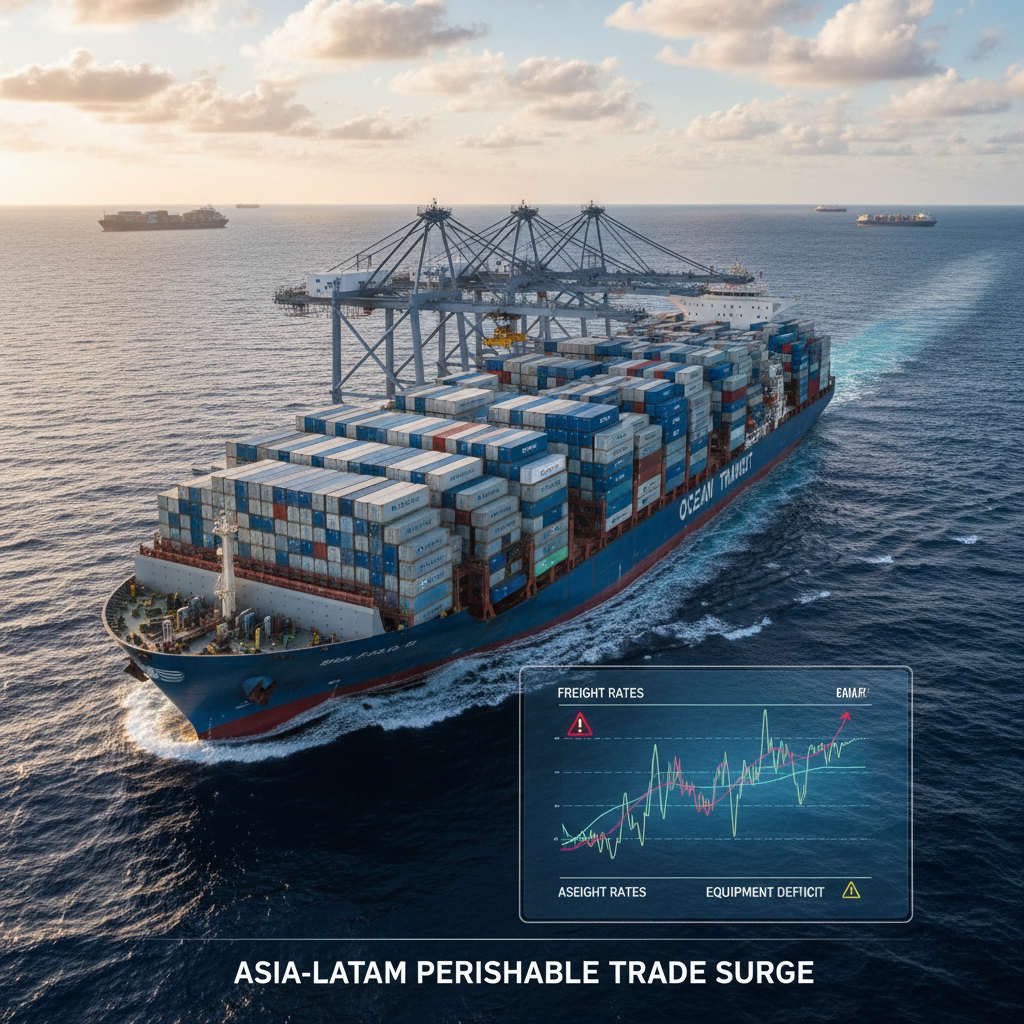
The shipping industry is witnessing an unprecedented Asia-Latin America reefer capacity expansion, driven by nearshoring and the booming perishables trade. Deployed container capacity on this lane has doubled over three years, exceeding 2 million TEUs in early 2025. Data indicates a 20% year-over-year capacity growth from 2024 to 2025, underscoring shifts between Asian manufacturing hubs and Latin American markets.
To accommodate demand, carriers are modernizing fleets. Ocean Network Express (ONE) introduced newbuild vessels on its Asia-West Coast South America service that are 50% larger to support perishables. Evergreen and Cosco have also expanded their services. This Asia-Latin America reefer capacity expansion directly connects ports like Busan with logistics nodes in Mexico, Colombia, and Peru.
Despite capacity injections, the reefer market faces bottlenecks. Carriers implemented rate increases of up to $1,000 per FEU to stabilize margins. Key challenges for 2026 include:
- Equipment Shortages: Latin America faced reefer equipment deficits of up to 73% during peak seasons due to extended Cape of Good Hope rerouting.
- Overcapacity Risks: Forwarders remain skeptical about filling continuous newbuild mega-ships.
- Rate Stability: While reefer rates are steadier than dry cargo, routing disruptions still strain availability.
This Asia-Latin America reefer capacity expansion offers immense supply chain opportunities, but lines must balance growth against equipment deficits.
References
SeaNews Turkey, Freight Rates Rise on Asia-Latin America Amid Capacity Surge, 2026. RSD Shipping, Asia-Latin America Trade Capacity Doubles in Three Years, 2025. Hapag-Lloyd, Shipping from Asia to Latin America? A GRI is coming up, 2025. PortCalls Asia, Reefer freight rates seen steady in Q1 2026, 2026. DHL Global Forwarding, Ocean Reefer Market Update, 2025.