

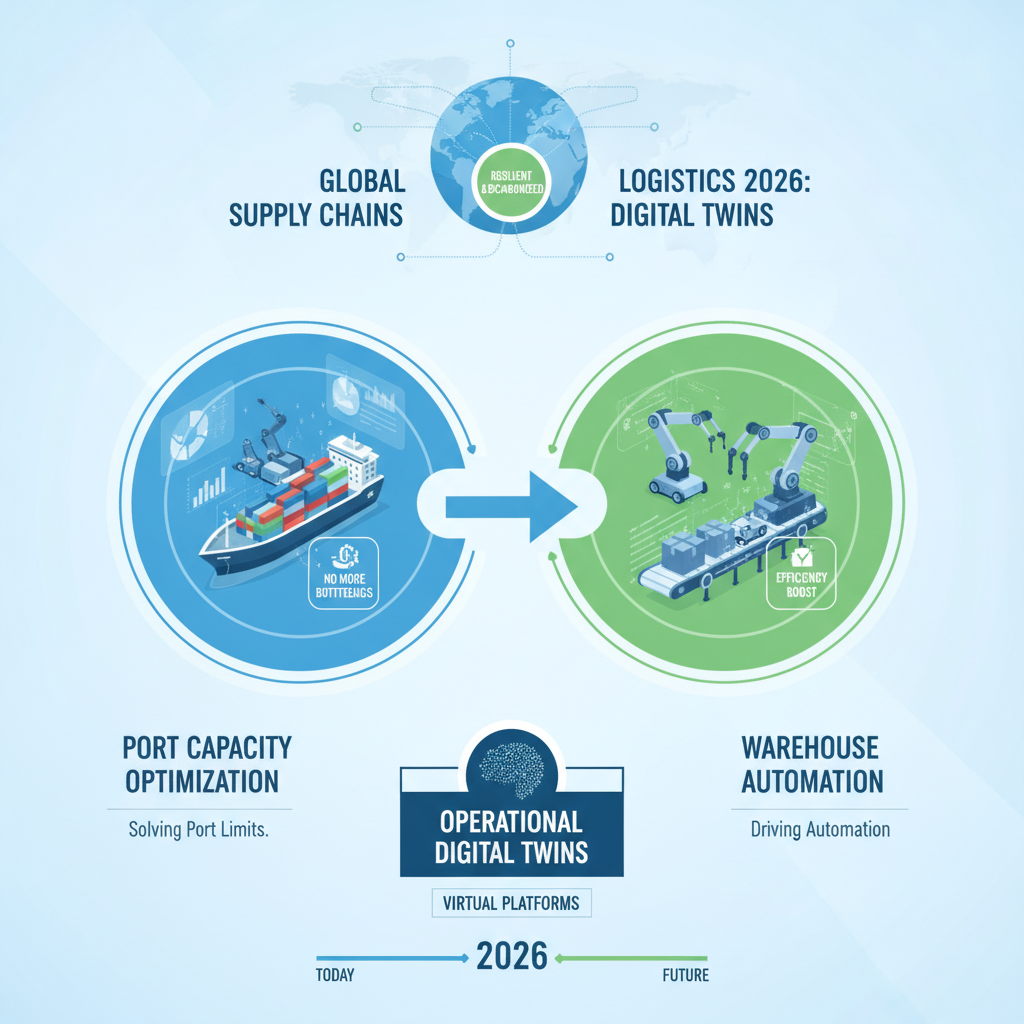
The Rise of Operational Digital Twins
As global supply chains navigate unprecedented capacity constraints, Operational Digital Twins are transitioning from theoretical concepts to essential decision-making engines. With the global container vessel fleet expanding by 10.7% in recent years, port operators face critical space and throughput limitations. In response, maritime and logistics experts are increasingly adopting Operational Digital Twins to synchronize real-time data across vessels, terminals, and road flows.
Driving Efficiency and Decarbonization
In 2026, the technology is delivering measurable gains across warehouse and maritime environments. Industry analysts project that by 2027, over 25% of warehouses will be highly automated, relying heavily on virtual testing before capital deployment. Key benefits driving this adoption include:
- Predictive Throughput: Leading operators report up to 2-3x productivity gains in robot-enabled picking by testing workflows virtually.
- Emissions Tracking: Regional hubs like the Port of Larne and Port of Brisbane are utilizing operational models to establish verified carbon baselines and optimize vessel speed, significantly reducing their environmental footprint.
- Financial Resilience: Between January and August 2026, the digital twin sector secured $309 million in funding, highlighting sustained investor confidence in enterprise-scale simulation platforms.
Future-Proofing the Supply Chain
Unlike static dashboards, Operational Digital Twins explain why disruptions occur and predict future bottlenecks. By merging physics-based equations with AI algorithms and IoT sensor data, these platforms allow logistics providers to execute risk-free scenario testing. As regulatory pressures mount, relying on dynamic virtual replicas is no longer optional—it is a baseline requirement for competitive supply chain resilience.
References: FlexTerm: How AI and Digital Twins Drive Port Growth (2025). Ziegler: 2026 Delivery trends and logistics shifts (2025). Digital Catapult: Helix8 and Larne Harbour (2026). DHI Group: How to reduce carbon footprint of vessel traffic (2025). New Market Pitch: Digital Twin Funding Tracker (2026). Digetiers: Best Enterprise Digital Twin Platforms (2026).