

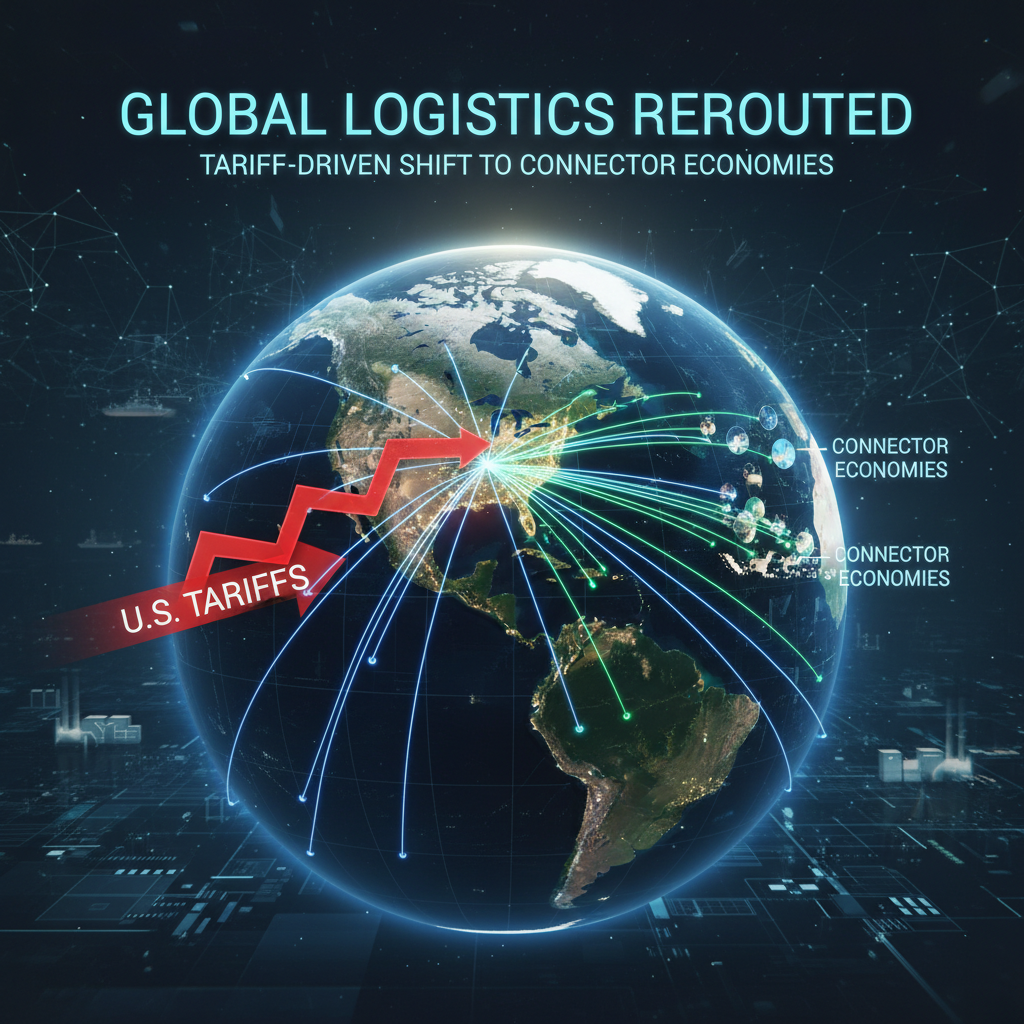
The global logistics landscape is undergoing a massive transformation as businesses pivot to avoid escalating trade penalties. Tariff-driven supply chain rerouting has become a primary survival strategy for importers facing unprecedented costs. With the average effective U.S. tariff rate reaching 19% in early 2026, companies are abandoning traditional sourcing models in favor of connector economies.
Despite geopolitical frictions, global trade volume remains resilient, forecasted to grow by 3.5% in 2025 and 1.3% in 2026. This sustained growth is largely attributed to agile tariff-driven supply chain rerouting through nations like Mexico, Vietnam, and India. Recent industry studies highlight substantial manufacturing shifts across multiple sectors.
- A 2025 Deloitte study predicted 40% of U.S. firms would relocate at least part of their supply chains to North America by 2026.
- Chinese imports face volatile tariff rates averaging 54-55%, compared to Mexico’s baseline 25% under current agreements.
- Tech giants are planning to move 15% to 20% of critical manufacturing into India and Vietnam by 2026 to mitigate these duties.
The frictionless era of international trade is officially over. While nearshoring and rerouting provide immediate relief from retaliatory duties, these strategies introduce new complexities. Companies must now balance lower tariff exposure against the logistical hurdles of cross-border trucking delays and higher compliance burdens.
References
- SupplyChainBrain: How Tariffs Are Reshaping Global Supply Chains in 2025 (supplychainbrain.com)
- The Nearshore Company: Tariffs China vs Mexico Data (thenearshorecompany.com)
- Allianz Trade: Trade Resilience (allianz-trade.com)
- Sensos: What Do 2025 Tariffs Mean for Your Supply Chain? (sensos.io)
- Indiana Business Research Center: International Outlook for 2026 (indiana.edu)