

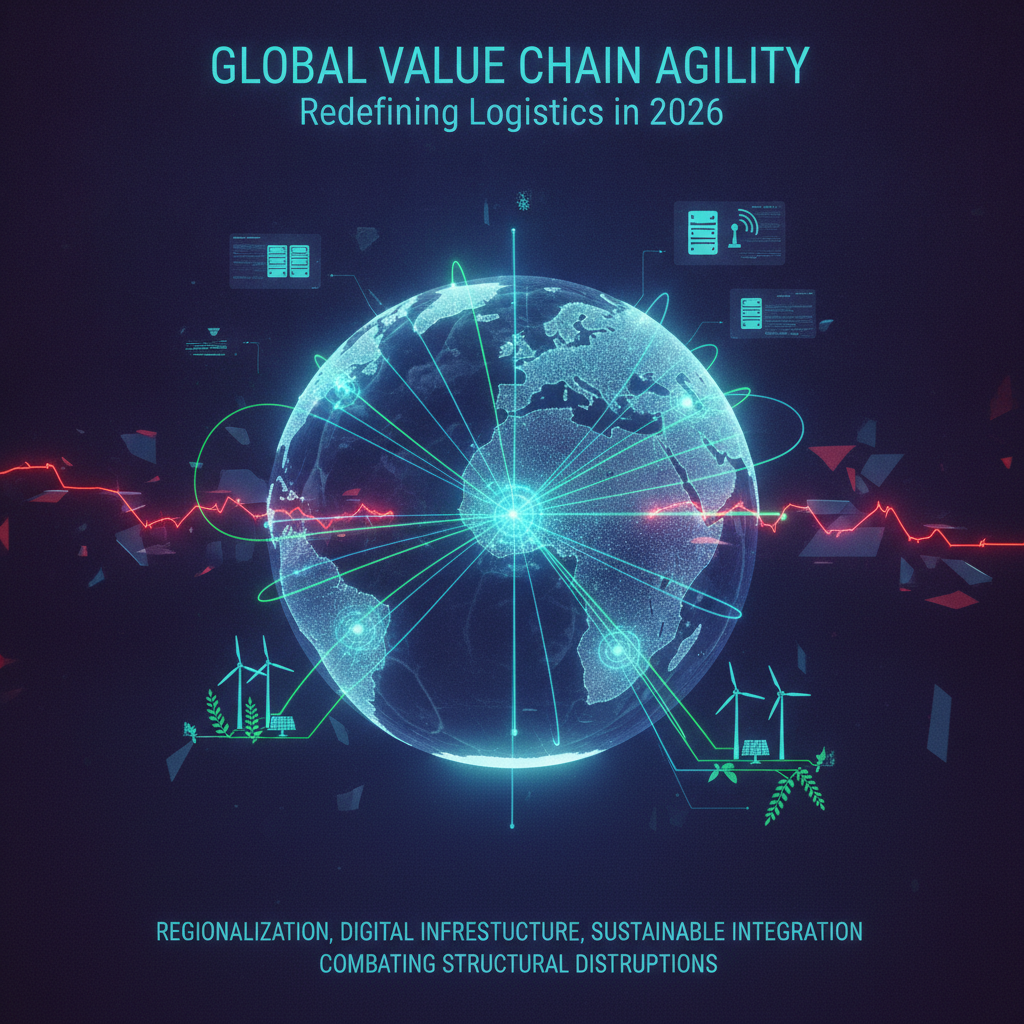
Since the massive disruptions of the early 2020s, logistics experts have moved beyond prioritizing mere cost-efficiency. In 2025 and 2026, Global Value Chain Agility has become the core operational mandate for enterprise survival and structural resilience.
According to the 2025 Global Value Chain Development Report, globalization is rapidly being reconfigured rather than reversed. Supply networks are adapting through regionalization, digital integration, and diversification to ensure resilience against geopolitical and climate-related shocks.
Modern agile networks rely heavily on Industry 4.0 enablers to maintain real-time visibility. Big data, IoT, and advanced predictive analytics now form the backbone of Global Value Chain Agility, allowing organizations to balance lean efficiency with responsive flexibility.
Recent European Union statistics reveal that 80% of enterprises faced severe value chain constraints in recent years, prompting rapid strategic reorganizations. To combat this, industry leaders are investing in multi-tier supplier visibility to preemptively manage bottlenecks and mitigate energy cost fluctuations.
Competitiveness in this new era of reglobalization requires a structural recalibration of logistics networks. To achieve true Global Value Chain Agility, logistics leaders are focusing on three primary strategies:
- Regional Diversification: Shortening supply chains and establishing localized production hubs to reduce cross-border latency.
- Digital Infrastructure: Implementing interoperable, paperless trade systems that lower transaction costs and boost real-time tracking.
- Sustainable Integration: Linking digitalization with green innovation and circular economy practices to meet stringent 2026 climate regulations.
Embedding proactive risk management within the supply chain not only safeguards operations but establishes agility as a measurable competitive advantage.
References
Global value chain disruptions and enterprise responses in the EU Statistics Explained – European Union
Resilience and Reglobalization: Global Value Chain Trends and New Opportunities – IDE-Jetro
Manufacturing Supply Chain Resilience Amid Global Value Chain Reconfiguration – MDPI
2025 Global Value Chain Development Report – EdSpace