

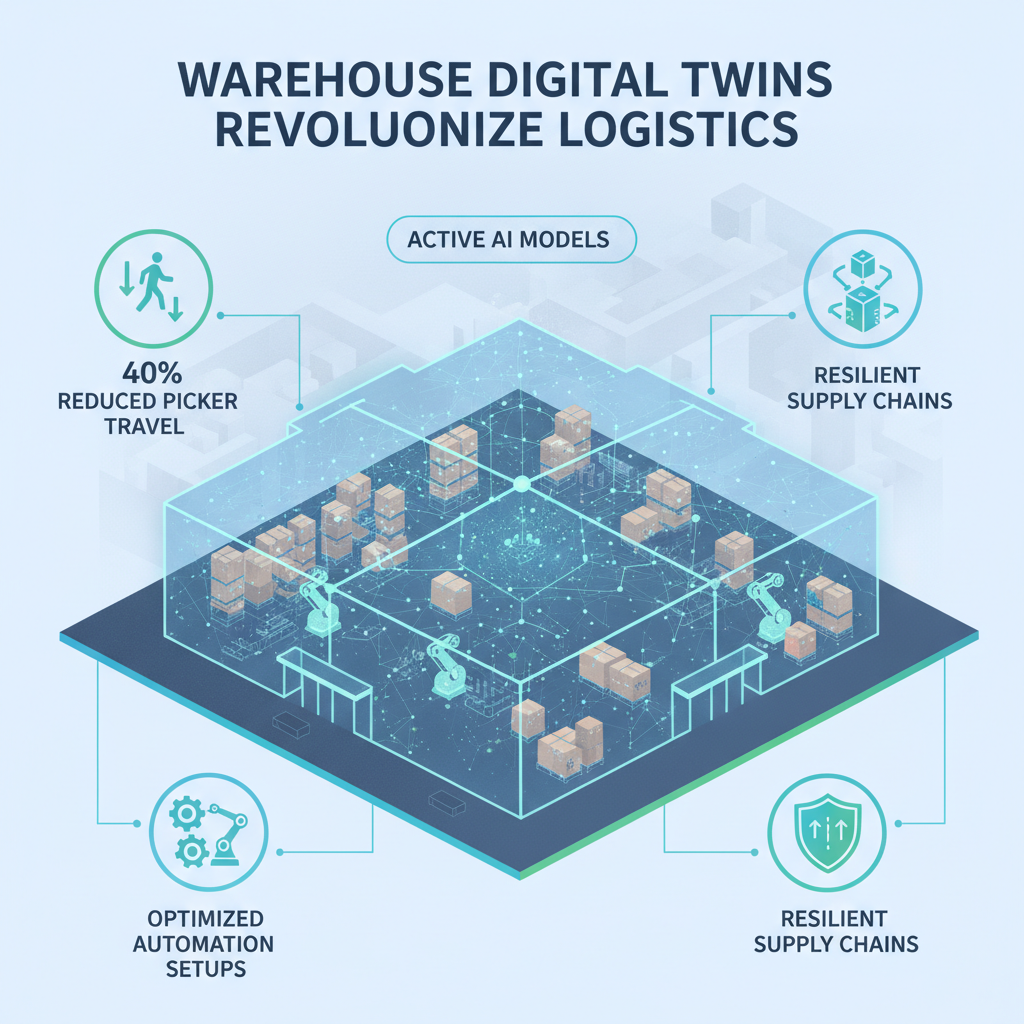
The Era of Active Operational Engines
The logistics landscape is rapidly evolving, and Warehouse Digital Twins have officially transitioned from passive 3D models into active, AI-driven operational engines. By creating a real-time, virtual replica of a physical facility, supply chain experts can seamlessly model, monitor, and optimize intralogistics before committing to costly physical changes. North America currently leads this technological shift, accounting for roughly 32% of the adoption market, though global acceleration is rapidly closing the gap.
Data-Driven Efficiency and ROI
Today’s Warehouse Digital Twins leverage computer vision, IoT sensors, and agentic AI to tackle complex fulfillment challenges head-on. Recent logistics data indicates that utilizing these virtual environments can drive massive improvements in operational efficiency. Key benefits observed by early adopters include:
- Reducing warehouse picker travel distances by 25% to 40% through intelligent order clustering.
- Lowering product loss rates in temperature-controlled cold chain logistics by 25% to 30%.
- Enhancing overall inventory accuracy up to 100% and boosting cycle counting speeds by 40%.
Future-Proofing the Supply Chain
As electrification and warehouse automation surge, energy management has emerged as a crucial operational constraint. Warehouse Digital Twins allow facility managers to run predictive scenarios to optimize AMR fleets, stagger robot charging, and prevent peak-load grid instability. With the broader warehouse management system market valued at $4.32 billion in 2025 and projected to reach $20.24 billion by 2035, these AI-powered digital replicas are no longer an optional luxury but a vital necessity for resilient operations.