
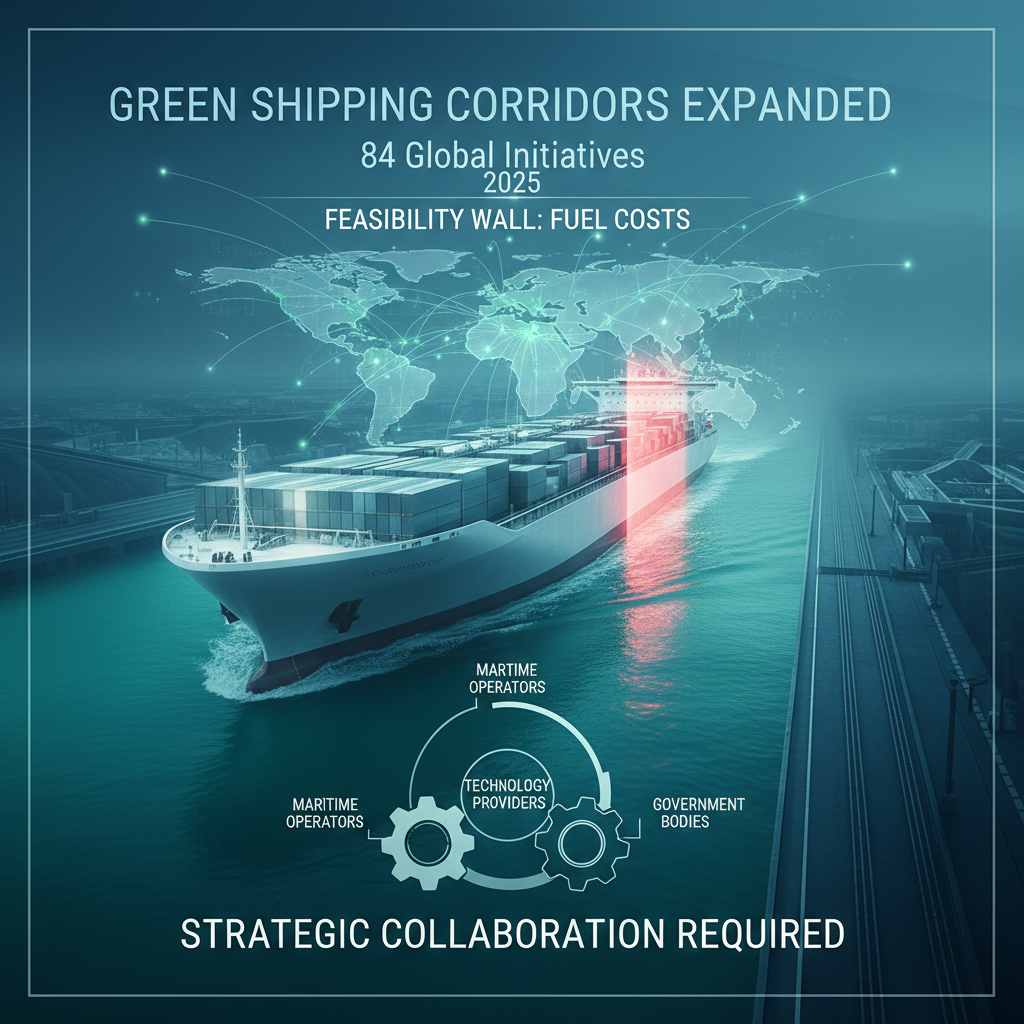
The maritime industry is reaching a pivotal midpoint on the path to 2030, with Green shipping corridors serving as the primary transitional tool for decarbonization. As of late 2025, 84 green corridor initiatives are actively advancing worldwide, including 25 newly launched corridors this year. Significantly, emerging economic powerhouses such as China, India, and Brazil are now heavily investing in these designated zero-emission routes.
Despite this geographical expansion, the progression from exploration to realization is facing significant friction. The 2025 Global Maritime Forum report cautions that many initiatives are currently stalled by a commercial feasibility wall. Key challenges delaying deployment include:
- Persistent cost gaps between conventional and zero-emission marine fuels.
- The IMO postponing its Net-Zero Framework decision to October 2026, delaying crucial market-based fuel standards.
- Governance uncertainties inhibiting complex, multi-stakeholder investment decisions.
To overcome these barriers, logistics stakeholders must treat Green shipping corridors as strategic economic infrastructure rather than mere environmental pilots. To advance projects into reality, maritime leaders should adopt the following strategies:
- Implement programmatic governance approaches to streamline decision-making.
- Develop innovative commercial chartering arrangements to aggregate fuel demand.
- Establish collaborative risk-sharing mechanisms across the entire logistics supply chain.
References
ctfassets.net – Global Maritime Forum 2025 Progress Report
climateactiontracker.org – International Shipping 2026 Update
spglobal.com – New green shipping corridors emerge