

The Rise of Transpacific Pre-Tariff Defensive Booking
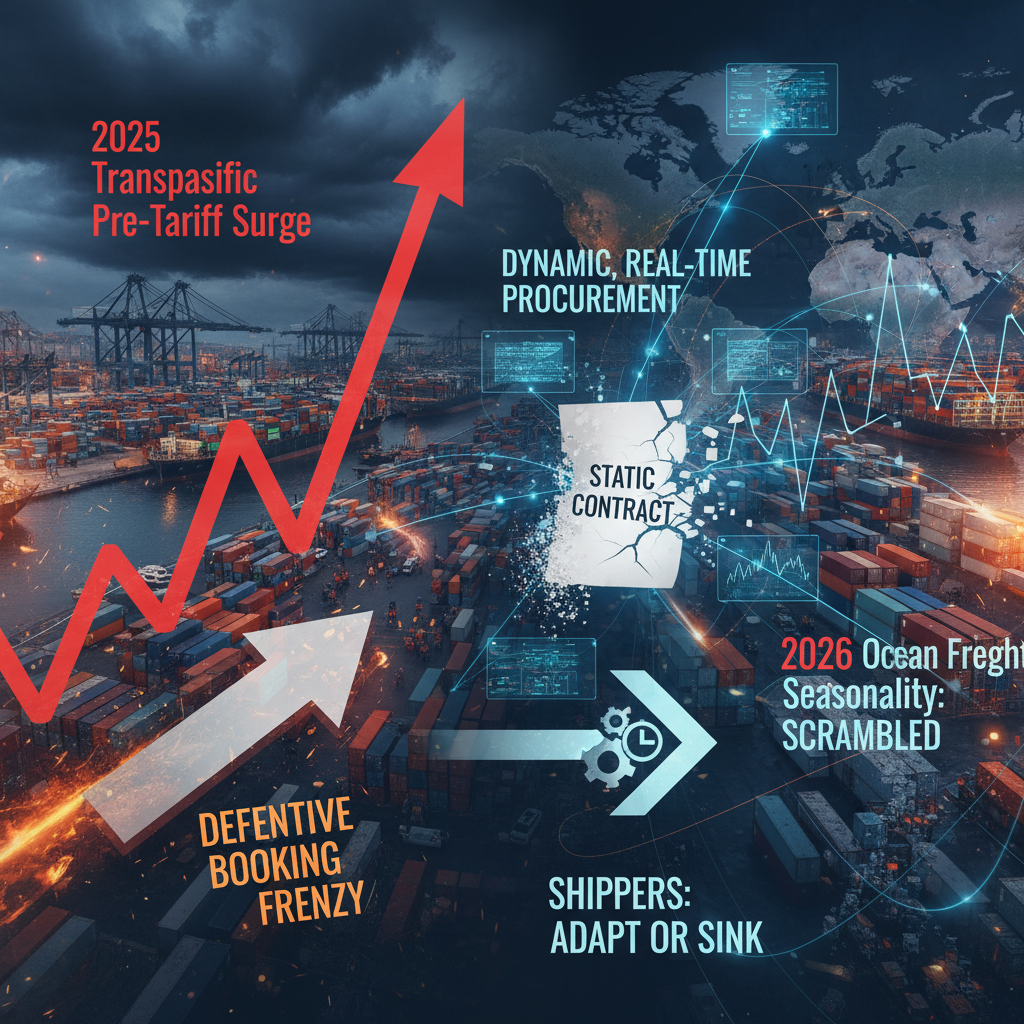
In the wake of sweeping 2025 trade policy shifts, Transpacific pre-tariff defensive booking has fundamentally scrambled ocean freight seasonality. As importers aggressively frontloaded container bookings to beat looming US-China tariff deadlines, the market experienced a massive supply chain distortion. This frontloading boom has now transitioned into a pronounced bust, with the Port of Los Angeles processing roughly 812,000 TEUs in January 2026—a stark 12% year-over-year decline.
Why Transpacific Pre-Tariff Defensive Booking Alters Procurement
The traditional 12-month ocean freight contract is rapidly losing relevance. Driven by over 110 trade policy decisions in a single year, Transpacific pre-tariff defensive booking strategies forced shippers to rethink procurement entirely. The subsequent drop in demand and structural oversupply have driven spot rates down dramatically.
- Spot Rate Plunge: By February 2026, Far East to US West Coast spot rates plummeted to just $1,889 per FEU.
- Contract Liability: Tariff volatility has transformed fixed annual agreements into unpredictable financial liabilities.
- Dynamic Procurement: Logistics leaders are now shifting toward algorithmic, real-time spot market auctions to manage exposure.
Mitigating Transpacific Pre-Tariff Defensive Booking Risks
Carriers are desperately attempting to defend their pricing floors by implementing aggressive capacity cuts, including blank sailings that reached 60% on Asia-Pacific Southwest routes in early 2026. For logistics experts, mastering the volatile cycles of Transpacific pre-tariff defensive booking requires abandoning static forecasting. Shippers must leverage real-time data and agile freight exchanges to capitalize on the current buyer’s market before the next wave of trade restrictions hits.
References: Optimizing Trans-Pacific Container Flows: How Real-Time Data and Reverse Auctions Are Mitigating 2026 Tariff Volatility, Container-News, February 2026.